
14 February 2026
How to hold a Core Recovery pilgrimage
Major Lynne Shaw

Core Recovery Development Officer Major Lynden Gibbs talks to Major Lynne Shaw about going on a pilgrimage.
Core Recovery is an invitation to discover a place and a group where you can be yourself, ask questions, explore faith and recovery, and move forward – a place of welcome, belonging and healing. It is a spiritual community that supports each other through recovery, whether that is recovery from addictive substances, poor health or life situations. Out of this has come a one-day pilgrimage experience, which a number of groups around the country have already enjoyed. A pilgrimage guide is available for anyone to use, and the resource is suitable for many other groups of people. At this week’s Mission Conference, people are experiencing part of that pilgrimage experience.
There are many benefits to walking, talking, stillness and silence. These days they are well documented. The Core Recovery pilgrimage provides opportunities for all these, with the added advantage of being rooted in the with-ness of Jesus and fellowship with one another.
Lynden explains: ‘It’s an intentionally spiritual journey, bringing Jesus in – that’s the strong part of the recovery. The second bit is fellowship, which everybody needs; it brings you on a journey with people and builds deeper bonds. Walking outdoors is shown to help recovery: exercise produces endorphins, which make you feel better, so you end up fitter and can feel good about yourself. It’s quite grounding!’
The guide to the pilgrimage has four stages – including a time for solo reflection and quietness – although Lynden explains the order can be changed and the material adapted to suit the context. A bag of objects is given to each participant, designed to prompt questions, conversations and become a physical reminder of the ongoing journey with God.
‘There’s all sorts,’ Lynden shares. ‘A pearl, a tiny figure of Jesus, a cross, a heart, a sheep. They’re little hints to start people talking: what do you think this means? Taking the bag away with them is about asking: “So what now?”’
‘At Core Recovery we’re there to journey with Jesus, to challenge ourselves in terms of anything we can do better, anything we can do more of,’ he continues. ‘During the last stage of the walk we’ll remember people, and everybody will have one or more stones that we’ll then put down. It might be in remembrance of somebody or to represent something that’s challenged you on the pilgrimage. We end up with a bit of a cairn that we either leave or move to somewhere significant.’
With more than 200 people expected across the Mission Conference’s two parts, the group size has been limited to give a genuine taste of the pilgrimage.
‘With a group of, say, 40, you can still get around to people, starting conversations, connecting people to each other,’ says Lynden. ‘For about an hour we’ll focus on one stage. It’ll be nice to get people talking about their route to Jesus. There’s a beauty in that, and to think about what Jesus is doing in your life.’
On the full pilgrimage, that part is usually the second stage, after people have had an opportunity to get to know one another. The stages happen slowly, over the course of a whole day so that gradually people’s guards come down. At the Mission Conference the pilgrimage taster is happening between the two main blocks of teaching.
‘With a group of Salvationist leaders we can be a bit more focused; it’ll be great for them to speak Jesus to each other,’ says Lynden.
The result is an environment for meaningful talking and deep connections.
‘I’ve had some great conversations,’ Lynden shares. ‘I was sat with a guy experiencing homelessness, talking together, and he said to me, “So what’s Jesus doing in your life?” It felt like such an opportunity, and we chatted together about what Jesus was doing in both our lives. His testimony was very strong. Inclusive is the word. It’s what the pilgrimage is designed to be, and empowering – it’s good to get into the habit of speaking about your spiritual journey.’
Written by
Major Lynne Shaw
Editorial Assistant, Publishing Department
Discover more

Major Ann Montgomery reflects on the Mission Conference theme of Intero and calls us into deeper faith, community and mission.
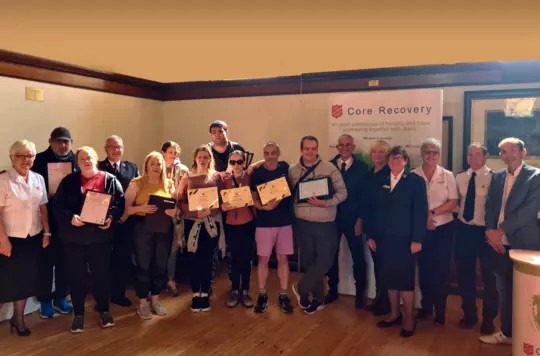
Major Lynden Gibbs and Major Nicky Watson help Stevie Hope understand The Salvation Army’s Core Recovery model.
Material to support Core Recovery centres with resources around pilgrimage and prayer

Previous Traitors winner Harry Clark reflects on his own experiences of the competition and reveals how a pilgrimage set him back on the right path.