
3 January 2026
Ethical banking: Getting to know Reliance Bank
George Tanton
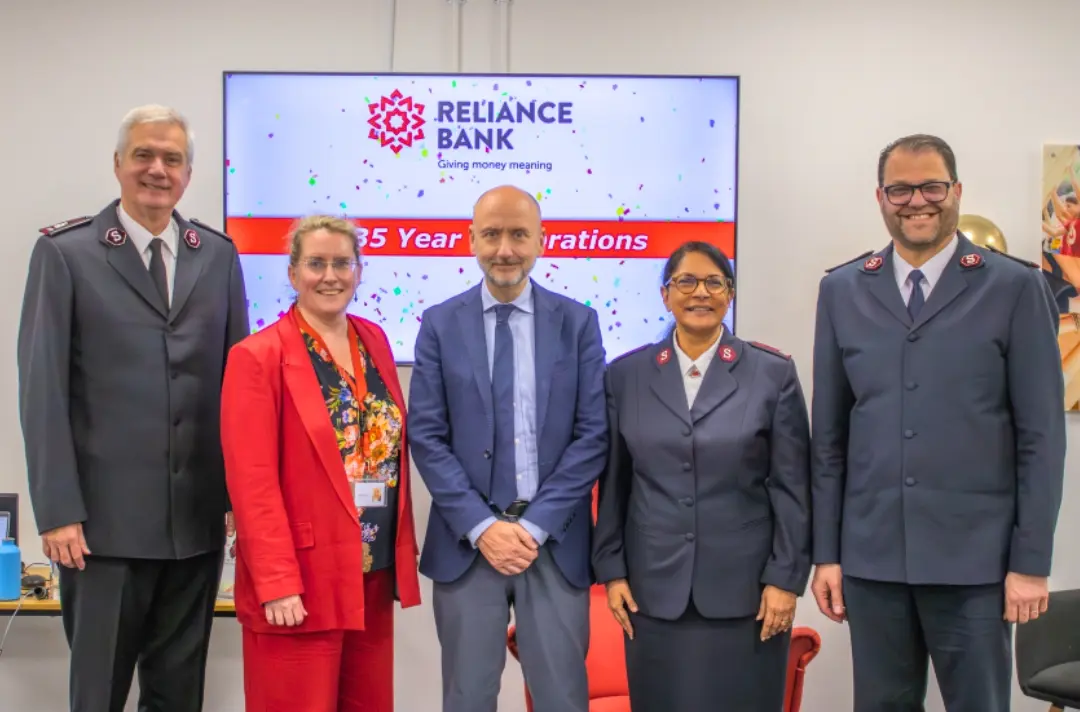
Nikki Fenton talks to George Tanton about how The Salvation Army's bank puts people over profits.
Originally founded in 1890 as The Salvation Army Bank, Reliance Bank celebrated its 135th anniversary last year. Holding deposits for more than 30 territories, the bank is completely owned by the Army, donating £8 million to its parent organisation over the past 15 years. Up to 75 per cent of its profits go directly back into The Salvation Army International Trust to fund the Army’s evangelical and charitable projects around the world.
Reliance Bank prides itself on being an industry pioneer in ethical banking. The term applies to any financial industry service that makes a conscious effort to align its lending policies and investments with positive social and environmental impact.
‘Unlike traditional banks, ethical banks are guided by principles or goals that improve the environment and society,’ says Nikki Fenton, Chief Executive Officer for Reliance Bank. ‘This could be, for example, a bank that provides loans to charities or refuses to invest in the mining of fossil fuels.’
Ethical banking involves refraining from any dealings that could harm people or the planet. That can include refusing to invest in alcohol, gambling, pornography, tobacco, weapons, conflict minerals, human rights failures and lack of labour rights, animal testing, factory farming, deforestation, fossil fuel energy and corruption.
Many high street banks have links to such ethically problematic businesses, with customers unaware of where their money is being invested.
‘When you deposit money into your current account or savings account, it doesn’t just sit in a vault – it gets invested,’ Nikki explains. ‘The bank makes a return by investing your money, or by providing loans to businesses. If ethical principles are important to you, it’s worth taking the time to research a bank’s investments and ethos to ensure you’re happy with how your money is being used. For instance, does it finance fossil fuels or invest in weapons manufacturing?’
Corporate social responsibility and integrity are consequently at the forefront of Reliance Bank’s operations, putting people before profit and being transparent with their customers on where their money is being invested.
‘Because of our size and our shareholders, we can be selective about our customers,’ Nikki expresses. ‘We want depositors to be confident that their money really is going to support a positive impact in society.’
In 2025, Reliance Bank’s funding has helped reduce hunger for 6,140 people, provided 366 healthcare bed spaces and supported 6,400 people with community centre facilities. Reliance Bank aligns its lending policies to the United Nations Sustainable Development Goals, a blueprint that helps reduce poverty, protect the environment and improve people’s lives.
In 2025, for the second year running, Reliance Bank was awarded Community Lender of the Year by the UK-based National Association of Commercial Finance Brokers. This was in recognition of its commitment to funding health and social care providers, affordable housing projects, food banks and treatment centres for individuals affected by gambling-related harm. Furthermore, Reliance Bank has signed HM Treasury’s Women in Finance Charter to encourage fairness and gender balance at all levels of the financial services industry.
Currently, the bank offers personal savings accounts as well as business and charity current accounts.
‘Being an ethical bank does not mean our borrowers do not have to repay their debts,’ says Nikki. ‘Our values are reflected in how we deal with customers who get into financial difficulties, our partnership with them – to work through difficult circumstances – is what sets us apart.’
‘Social good is at the heart of the bank’s mission, delivering positive societal outcomes aligned to the mission of the Army,’ she adds. ‘We are a small bank, an unsung hero striving to do the right thing in a complex landscape.’
- To find out more about Reliance Bank, visit reliancebankltd.com.
Written by

George Tanton
Editorial Assistant
Discover more

Major Beverly Baker (THQ) talks to Ivan Radford about acting with integrity.

Salvationist explains new changes to The Salvation Army’s boards and councils and how they fit together.

Connect with teams ready to share resources and explore opportunities that can support local mission.