
27 March 2026
The latest on… assisted suicide

The Public Affairs Unit provides an update on The Salvation Army’s campaign against assisted suicide legislation within the UK and Ireland Territory.
Thank you to everyone who has been supporting the Public Affairs Unit’s work on assisted suicide legislation across the UK and Ireland Territory. The team has been busy with bills in Scotland, in the Holyrood parliament, and in England and Wales, in the Westminster parliament, and has been monitoring developments in Jersey and the Isle of Man. This update is to let you know how things currently stand in each area, as of 23 March 2026.
Scotland: Holyrood Bill defeated at final vote
On 17 March, after a passionate and moving debate in the Scottish Parliament, MSPs voted against the Assisted Dying for Terminally Ill Adults (Scotland) Bill by 67 votes to 59 with one abstention. As a result, the Bill will not become law. Its sponsor, Liam McArthur MSP, has said that he will not seek to reintroduce the bill after the 7 May election. However, it is possible that another MSP could seek to introduce a bill in the future.
England and Wales: Westminster is running out of time
The Terminally Ill Adults (End of Life) Bill, which would cover England and Wales, is still progressing through the House of Lords. Members of the House of Lords believe the Bill is so badly written that more than 1,000 changes have been proposed and extraordinary amounts of time have had to be allocated to debate what changes need to be made.
In Wales, the Senedd recently voted in principle to allow Wales NHS to support assisted suicide, but this would only happen if the Terminally Ill Adults (End of Life) Bill becomes law – and it is looking highly unlikely that it will.
Although members of the House of Lords are now sitting for extended sessions every Friday until 24 April, the Bill will almost certainly not have completed its passage through the House of Lords by then. Even if it does, it will be practically impossible for the House of Commons to consider any proposed changes before this parliamentary session ends at the beginning of May. This means that, to all intents and purposes, the Bill will probably not become law.
Again, it is possible that one or more MPs will attempt to reintroduce the Bill, or a similar one, in the future. As in Scotland, the Public Affairs Unit will be monitoring developments.
Other assisted suicide legislation in the UK and Ireland Territory
The Isle of Man and Jersey parliaments have both passed bills legalising assisted suicide. These bills are awaiting royal assent.
A senior member of Guernsey’s States of Deliberation has announced that, in the next three years, he will seek to bring in a bill to legalise assisted suicide.
In the Republic of Ireland, a joint committee of the Oireachtas (parliament) recommended legalisation of assisted suicide in 2024, and the Dáil – the lower house of the Oireachtas – accepted the committee’s report, but so far there have been no attempts to pass this into law.
In Northern Ireland, there are no assisted suicide bills in progress, and the Public Affairs Unit is not aware of any proposals to introduce any at present.
What The Salvation Army is doing
At THQ, the Public Affairs Unit is considering what The Salvation Army’s next steps will be, in light of the defeat of the Assisted Dying for Terminally Ill Adults (Scotland) Bill at Holyrood and the likely failure of the Terminally Ill Adults (End of Life) Bill at Westminster.
A senior leadership team is also gathering to work out how the legalisation of assisted suicide in some parts of the territory will affect The Salvation Army’s ministry and services.
What you can do
In line with The Salvation Army’s International Positional Statement on Euthanasia and Assisted Suicide, The Salvation Army has campaigned against the Holyrood and Westminster assisted suicide bills.
This is a complicated issue and people’s views will be shaped by their experiences. The Army’s positional statements provide guidance to members, but it is understood that individuals may have different views and the Army does not condemn anyone who does. While Salvation Army officers are expected to align their teaching and counsel with this positional statement, the Army remains committed to offering services, fellowship and support to all, regardless of their position on this issue.
As the debate continues, whatever your perspective is, please pray:
- For wisdom and clarity for the Public Affairs Unit and those the team works alongside and partners.
- That The Salvation Army can continue to build good and productive relationships with politicians and others in the various parts of the territory.
- That underlying questions about sanctity of life and protection of vulnerable people will be explored seriously and compassionately.
- For comfort for all those affected directly, who either fear or hope on this matter.
For further reading and other materials, visit salvationist.org.uk/assisted-suicide.
Discover more

The Salvation Army is calling on the UK government to oppose assisted suicide and protect vulnerable people.
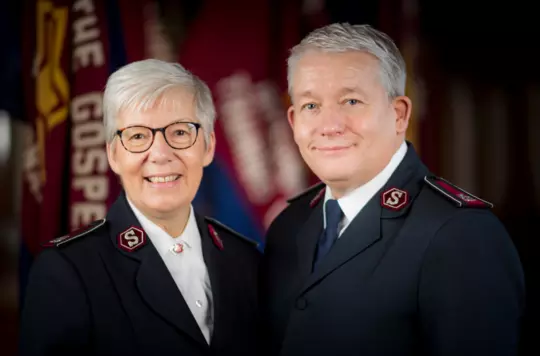
Territorial Leaders Commissioners Jenine and Paul Main share a pastoral letter on the topic of assisted suicide.

As the assisted suicide Bill returns to parliament, Lieut-Colonel Nick Coke highlights the Army’s concerns.