
8 August 2026
Psalm 95: Sing for joy to the Lord!
Captain Hannah Webb
Captain Hannah Webb calls us to heartfelt worship.
Key text
- Psalm 95
First and foremost, this psalm is about worship – the importance of worshipping God, how we should worship and, crucially, why we should worship him.
Pause and reflect
- What does worship mean in an increasingly secular society?
Some people claim they have only been into a place of worship for weddings, baptisms, funerals or maybe Christmas. However, I would argue this view of worship is too narrow. Worship lives in our DNA. Football crowds and concertgoers are evidence of this. You only need to glance at the coverage of the mania surrounding the Beatles and Elvis Presley in the 50s, 60s and 70s or, more currently, Harry Styles, Taylor Swift and [insert your favourite K-pop band here]. Devoted worship is intrinsic to human life.
Pause and reflect
- Who or what do you see people worshipping?
- How do you see them worshipping?
Psalm 95 begins with a call for the listener to join in the psalmist’s praise of the Most High, the One exclusively worthy of our praise. This is an exuberant, excited and exciting invitation for us to lend our voices to an ancient chorus, offered to the Lord as a joyful new tidal wave of worship. It is presented as an invitation but underneath lies the reality that to praise God is the only appropriate response for all that he has done for us.
Many scholars now believe that this psalm was written to a generation who were about to return from exile in Babylon, or who had very recently returned. The psalmist was encouraging people to also return to their proper worship of Yahweh. They had been in Babylon for generations, immersed in a culture where people worshipped multiple deities. The writer was reminding them of the one true God, who was bringing them back from exile, the God who was on the throne of Heaven, and who was exclusively worthy of their praise.

While we may not have been exiled, there can be times in our lives when we feel like our faith is being shaken. It is important to remind ourselves, and others, of who our God is, and to encourage each other to worship him.
Pause and reflect
- Who or what acts as a reminder to you of who God is and draws you back into worship?
- How could you increase your boldness in inviting others to worship God?
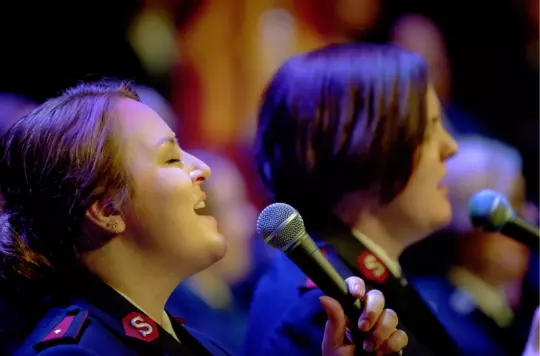
Throughout the psalm, the writer indicates that expressions of worship can be diverse. The writer gives examples of worshipful behaviours towards God: singing and shouting (see v1), making music (see v2), bowing down and kneeling (see v6). These are varied; some are loud, some are quiet. They require different postures – standing, kneeling and prostrating. Some involve movement, some don’t. This shows that there are many ways of offering our worship to God, all of which – when offered in a spirit of authenticity and joy – give him glory.
Joy is a key component of God-honouring worship (see v1). Whatever our worship expression, we must offer our heartfelt praise with an attitude of joy.
Pause and reflect
- What is your preferred or most natural way of coming before the Lord in worship?
- How could you contribute to the joyful attitude of your worship setting?
The heartbeat of Psalm 95 is its pendulum swing between the call to worship God and the reasons we have for worshipping him, which can be summarised in the simple, profound fact of God’s identity and what he has done for us.
The writer declares God’s ownership of the heights and the depths of the Earth (see v4), as well as the sea and the dry land (see v5). These contrasts speak of God’s lordship over all creation because ‘he made it’ (v5). He is worthy of our worship because he is the Creator.
The description of God as ‘the Rock of our salvation’ (v1) would have been taken as a reference to a military fortress. God is worthy of our worship because he is our protector.
In verse 7, the psalmist highlights God’s covenant character and his relationship towards us. God was and is the shepherd of the people of Israel, and he is our Good Shepherd today (see John 10:1–21).
The psalm then takes a bit of an unexpected turn, with the writer issuing a powerful challenge to the original audience: do not harden your hearts to God like your ancestors did (see vv8 and 9). Their ancestors’ generations had tested, angered and failed to listen to God in the desert (see Exodus 17:1–7). Indeed, their inability to worship God properly deprived some of them of the right to enter God’s Promised Land at all.
We, too, are challenged to listen to and trust God and not repeat the mistakes of previous generations. Our experiences of having to rethink communal worship during the Covid-19 pandemic and then returning to our congregations might give us something of an insight into what it means to return to and re-establish worship.
Pause and reflect
- In what ways did the Covid-19 pandemic change the way you or your congregation worship?
- Is God telling you to let go of anything in order to ‘sing a new song’ and refresh your worship?
We must ensure that we are worshipping joyfully in faith and in truth and establishing good patterns for the future. We are invited to be God’s co-workers in re-establishing his intended covenant relationship with his creation and the sheep of his pasture. We are called to worship God – our Creator and Good Shepherd.
So, will you come and sing a new song for joy to the Lord?
Bible study by

Captain Hannah Webb
Corps leader, Dartford
Discover more

Captain Marie Karičková believes God is worthy of our trust, even in the hardest times.

Captain Rob Westwood-Payne describes the extent of God’s love. Psalm 143

Salvationist asks people around the territory why they attend their corps.
Captain Callum McKenna encourages us to consider how worship helps us share the gospel.