
24 June 2026
Help us highlight the hidden reality of poverty
Chris Hartley

Chris Hartley calls us to join the Army’s campaign highlighting the challenges of real unemployment.
Poverty is never just a number. It’s the parents skipping meals so their children can eat. It’s the person whose mental health has suffered after months out of work. It’s the family weighed down by debt and the rising cost of living.
Being out of work can push people deeper into economic hardship, but poverty also creates barriers that make work hard to find and even harder to sustain. Poverty is not just the result of unemployment – it can also trap people in unemployment.
A new report by The Salvation Army shines a light on this hidden reality, because official unemployment figures do not tell the whole story. A key group that are missed are those who would like to work but are not currently looking or cannot start soon. According to our research and experience, this is because they face a number of complex barriers, such as caring responsibilities, ill health and the long wait for treatment, homelessness, digital exclusion, transport or a lack of suitable jobs in their area.
About 2.4 million people are in what we call ‘close to work real unemployment’. This includes both those who are officially classed as being unemployed and this hidden group. That figure is much higher than the 1.1 million people out of work who are receiving employment support through the benefits system.
This means about 1.3 million people are missing out on mainstream support – they may not be in touch with the benefits system, or may have lost trust in it. We believe there should be more flexible, community-based support for people who want to work but face barriers to getting there.
Sadly work is not always a guaranteed route out of poverty. Nearly half of UK working-age adults experiencing poverty are actually in employment. This calls into question the strategy of successive governments of pushing for ‘any job’, because it shows that just finding work is not enough to overcome poverty. Work that changes lives must be dignified, sustainable and provide a liveable income. It must be secure, well paid and provide enough hours for what an individual wants and needs.
This is something we see every day through our Employment Plus service, which supports people who are often furthest from employment and government support in 500 UK communities. Our approach is to support the whole person, and this reflects something fundamental about our Christian faith: Jesus never treated people as problems to be managed. He saw the individual, listened and responded with compassion. In the same way, we believe employment support must be rooted in dignity and hope, not simply compliance or pressure.
Proverbs 31:8 reminds us to ‘speak up for those who cannot speak for themselves, for the rights of all who are destitute’. That’s why our new report matters so much. We are called to put faith into action by serving others, defending human dignity and seeking justice for people pushed to the margins. For us, policy is not about numbers on a spreadsheet; it’s about people who are struggling and how they can be empowered.
This is why we’re campaigning for change. Our report recommends a more humane and decentralised approach to employment support that relies less on sanctions, particularly for those people facing complex barriers. Ultimately, it’s a question of what kind of society we want to be. Do we create systems that punish people experiencing poverty? Or do we build support that helps people to thrive?
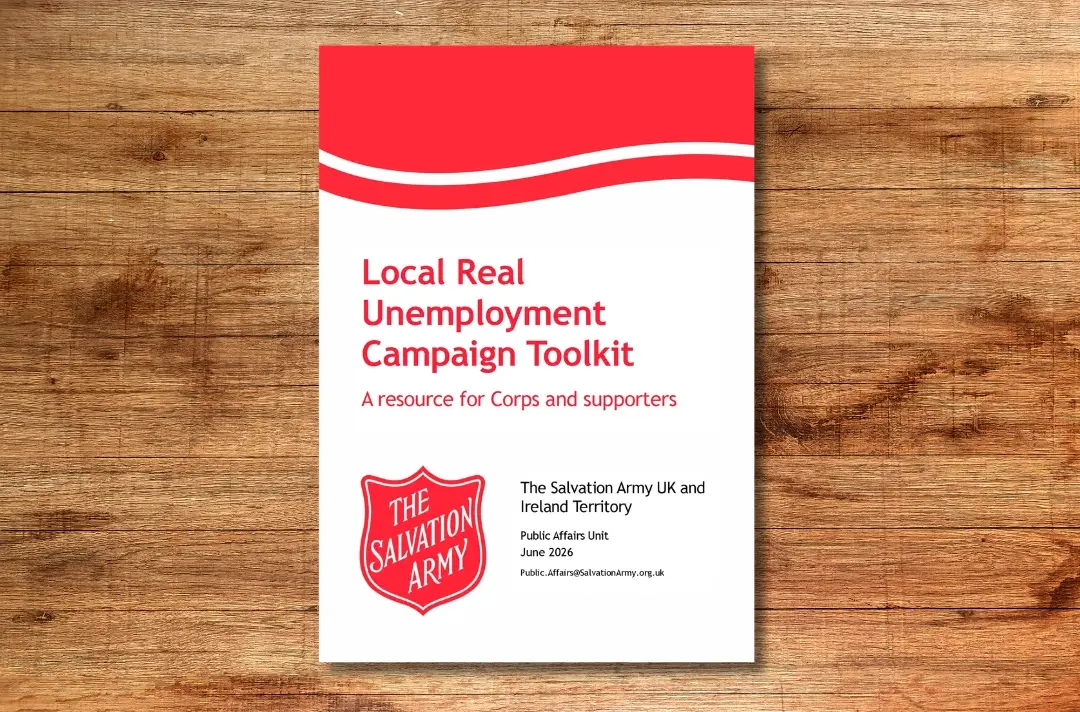
We need your help to share our findings with decision-makers across the UK and urge them to act. We’ve created a campaign toolkit to help you contact your local politician, which you can download below. You can help the voices and realities of people experiencing poverty be heard by those making the decisions. Together we can ensure that everyone can live in dignity and not despair.
Reflect and respond
- Read Proverbs 31:8 and 9. How can you listen to people in your community and speak up for people in need?
- Find out how you could collaborate with Employment Plus where you are by emailing employmentplus@salvationarmy.org.uk.
- Share the Army’s new report with politicians through resources in the Local Real Unemployment Campaign Toolkit below.
- Write to your MP or write to your MSP, MS or MLA.
Written by

Chris Hartley
Public Affairs Officer, Public Affairs Unit
Latest viewpoints
-

Single Friendly Church Week: How welcoming is your church?
At the start of Single Friendly Church Week (27 September – 4 October), Major Andrea Cooper reflects on singleness and how we value people.
-

70 Up: How have you changed as you have grown up?
As 70 Up concludes on ITV, Ivan Radford reflects on growing older.
-

Pray for Nepal and Tibet
After the catastrophic avalanche and flooding, we pray for all the people impacted.
-

Wildfires: Living out hope in the face of despair
In the light of recent wildfires, Major Lynne Shaw considers how we can respond by caring for creation.
-

Back to school: A lesson worth learning
Senior Deputy Head Andrew Mair reflects on the start of the new school year.
-

Is this an end to rough sleeping for good?
Jez Bushnell considers Andy Burnham’s first major promise as prime minister and the government’s commitment to tackling homelessness.
-

Ludwig: The value of a fresh perspective
As Ludwig returns to BBC One, Ivan Radford celebrates the unique ways our minds work.
-

Spider-Man: Brand New Day: Renewed spark
As Spider-Man: Brand New Day swings past superhero fatigue, Sam Bishton asks what renews your energy and passion.
-

The Odyssey: The importance of welcoming strangers
With Christopher Nolan's The Odyssey out now, Captain Chris Button reflects on the importance of hospitality.
-

Toy Story 5: Making time for connection
As Toy Story 5 plays on our screens, Naomi Blowers encourages us not to be distracted from being present with God.
-

The Piano: Playing with purpose
As Channel 4’s music series draws crowds at train stations, Ivan Radford celebrates the power of hearing why people play.
-

Meccha Chamelon: Not blending in
As the game Meccha Chameleon sells more than 15 million copies, Stevie Hope considers the impact of being seen.