
28 March 2026
Palm Sunday: Righteousness revealed
Lieutenant Hannah Carr

Lieutenant Hannah Carr reflects on Jesus’ example of humility and faith in practice not performance.
Have you ever experienced something that was different to what you expected? Like taking a sip of tea only to discover it’s coffee? Or riding a roller coaster you thought would be tame, only to discover it was full of stomach-churning drops and turns? It can feel disjointing and confusing, and you might struggle to know what to do.
Jesus’ entry into Jerusalem found in Matthew 21:1–11 can seem confusing when we compare it to our own expectations. When we read the title ‘Jesus comes to Jerusalem as king’, we expect an elaborate parade, largely because our culture has shaped our understanding of royal processions to be that way. So when Jesus arrives on a lowly donkey, we might be confused and affronted by something different from our expectations. Surely the King of all creation should be more impressive than this?
But what if an elaborate entry was never Jesus’ intention? Matthew’s quotation of Zechariah 9:9 heavily suggests that this was the entry God had always planned for his Son. After all, as Dane Ortlund in his book Gentle and Lowly observes, ‘Jesus provides new sharpness to who God is, but not fundamentally new content’. This is because the attributes of Jesus are not unique to him, but qualities of God’s Kingdom that he visibly and tangibly embodies. While the humility and lowliness of a donkey might seem to contradict the victorious King prophesied in Zechariah, in the context of God’s upside-down Kingdom it makes perfect sense.
Our confusion can be caused by our expectation and definition of the word ‘righteousness’. By our human standards, righteousness has become about being the best we possibly can be. We focus on doing the best to become righteous. Perhaps we have interpreted the idea that God can declare us righteous in the same way a judge declares a winner – we think we must earn righteousness through perfect actions and performance, so that God can bestow the prize of righteousness upon us. In reality, righteousness is not a status for us to achieve, but an attribute of God. It is not a tick-box exercise for us to complete, but an active choice for us to make the right decisions each day. It is a characteristic and behaviour that God reveals to us as the One who is most righteous, and it is our responsibility as disciples to reflect that righteousness into the world.
Jesus didn’t enter Jerusalem on a donkey because he wanted to prove himself humble and therefore become righteous, but because he was righteous in his very essence.
When we put too much focus on righteousness as a status to achieve, our faith can quickly become a performance rather than a practice. But this is not what God wants for our faith. He does not want us to spend time trying to win his favour and be declared the most righteous in comparison to all our friends. He wants us to spend time with him, to see his glory, and to experience the fullness of life he offers so freely. In his book Practicing the Way, John Mark Comer says that ‘salvation is less about getting you into Heaven and more about getting Heaven into you … less of a transaction and more of a transformation’. The purpose of our faith is not making ourselves worthy of getting into Heaven or earning salvation. It is about following Jesus because we believe in his cause and want to reveal the glory of his Kingdom here on Earth.
Romans 1:17 tells us: ‘For in the gospel the righteousness of God is revealed – a righteousness that is by faith from first to last, just as it is written: “The righteous will live by faith.”’ The best way that we can reveal God’s righteousness is by spending time with God and learning more about him. When we reveal his character to ourselves, seeing that righteousness first-hand, we cannot help but imitate him. We see his nature as perfect and praiseworthy, which changes our outlook on life and our priorities. We see a new way of life, the right way of life, set out before us, becoming clearer and clearer as we discern God’s direction. Suddenly, our perception of what is right becomes what God tells us is right, rather than our own opinions. Eventually, through the work and conviction of the Holy Spirit, the righteousness that was once hidden by duty and performance becomes visible to us in our thoughts, attitudes and, in turn, behaviour.
We act righteously not because we strive to earn God’s approval, but because we know that is what God is calling us to do as his disciples. As flawed and sinful beings, we make mistakes along the way but, as my cornet teacher used to tell me, practice makes permanent, not perfect!
Holy Week presents us with the ideal opportunity to see God’s righteousness revealed. We see Jesus’ entry into Jerusalem as an exhibition of his character, not his power. We see his death not as an act of performative selflessness, but as the ultimate sacrifice that makes salvation and righteousness accessible to all.
It is an opportunity to examine ourselves. How are you practising righteousness in your everyday life, not to create a Kingdom culture to our standards, but to reveal Kingdom values where they already are?
Written by

Lieutenant Hannah Carr
Corps Leader, Longton
Discover more
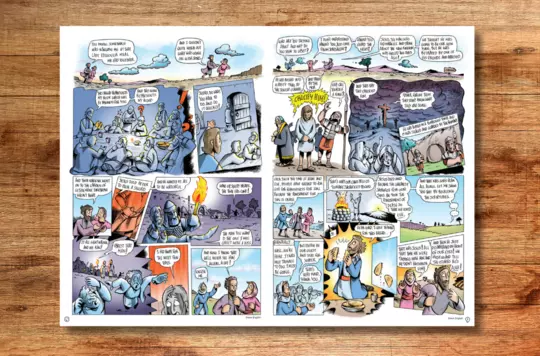
This year's Holy Week comic strip from the Kids Alive! Spring Special.
Devotions, podcasts, articles and resources to help you journey through and celebrate Easter.