11 July 2026
1 Peter 1: Born into a living hope
Captain James Pegg
Captain James Pegg reminds us of the inheritance we have in Jesus.
Key text
- 1 Peter 1:3–9
A recent television advert offering financial advice suggested: ‘Never shop on an empty stomach.’ I have to admit that I often do the opposite. I let my hunger dictate what I ‘need’, filling the trolley with things that would satisfy me in the moment. My wife regularly reminds me that we’re shopping not just for now, but also for the whole week! The more I think about it, the more I understand why she prefers to do the weekly shop alone.
That tension between now and yet to come runs through 1 Peter 1:3–9. Peter speaks of a ‘living hope’, which is present and active now. Yet, he also speaks of an ‘inheritance’ that is in the future and awaiting us. As Christians, we live in that in-between space: the now and the not yet. In Surprised by Hope, NT Wright describes us as ‘resurrection people’, living between the resurrection of Jesus and the day when God will make all things new. We have been born into a living hope and we await an inheritance where that hope is fully realised.
Pause and reflect
- What is the Christian hope?
- As followers of Jesus, what are we looking forward to?
- How might we live faithfully in between the now and the yet to come?

Let’s begin with the word ‘living’. Our minds immediately turn to Jesus. He is alive. We do not follow a person who simply lived well and died; we serve a risen Saviour. Our faith is not rooted in memory, but in a present reality. Jesus is alive and active, working with God and the Holy Spirit, in the beautiful mystery of the Trinity, to restore all things. ‘Living hope’ could also point to where our hope is found – in the present. As The Message paraphrases it: ‘We’ve been given a brand-new life and have everything to live for’ (v4). This is not a distant or abstract hope. It is immediate. It is something we experience in the day-today life of following Jesus. Jesus is the hope for my life today, not just my future. He is the hope for this world now, not only for what it will become.
Pause and reflect
- How does the truth that Jesus is alive shape your mindset, ministry and worship?
- If Jesus were only a historical figure, how would that change what you believe or how you live?
In our daily lives we have many different hopes and dreams, some of which may never become realities. Living hope is for here and now, something we can experience daily. In our Salvation Army contexts, I wonder how this kind of hope is being expressed.
Alongside this present hope, Peter introduces the idea of inheritance. For some, this can feel like a difficult concept and can bring to mind conversations that take place following a death. Perhaps it’s more helpful to think of inheritance in terms of what we receive and carry forward, such as traits or characteristics passed down through a family. People often say that my son has inherited my looks – to which I might reply ‘poor thing’ or ‘he didn’t ask for that’!
When Peter speaks of inheritance, he is pointing us to the future: ‘This inheritance is kept in Heaven for you … until the coming of the salvation that is ready to be revealed in the last time’ (vv4 and 5). Admittedly, the future can be hard to picture, especially when Scripture uses symbolic or unfamiliar language. However, Peter’s point is clear – God has something prepared for us.
There is a future reality we can confidently hope in.
Revelation 21 gives us a glimpse. It describes a new Heaven and a new Earth, where everything is made new: ‘“There will be no more death” or mourning or crying or pain’ (Revelation 21:4). This is the inheritance awaiting those in Christ. It is the full realisation of the hope we hold now. One day, the brokenness we experience will be restored and we ourselves will be made new.
Peter contrasts future hope with gold – something valuable yet ultimately perishable. Even the most precious things in this world do not compare to what God has in store! Our inheritance is not only better, but it’s also eternal.
Pause and reflect
- Does the vision in Revelation 21 match what you hope for?
- What does Peter’s comparison with perishable gold say about what truly lasts?
We need to consider where our hope is primarily focused – the present or the future – and how we can hold both together in a healthy way. This brings us back to the questions I posed earlier: how do we live in the in-between? How do we hold a living hope for today while also looking towards what is to come?
Peter offers an answer in verse 8: ‘Though you have not seen him, you love him; and even though you do not see him now, you believe in him and are filled with an inexpressible and glorious joy.’
Peter gives us two things to live by as we hope and wait: love and joy. We continue to be a people of love and are devoted to God. Then, in response, we love the world he has created and to which he calls us to minister. We also live in joy – a joy that can’t be contained and shows those around us that we are living with a hope that transforms our present and gives us an assurance for the future.
Pause and reflect
- How can we live with hope that marks our present?
- Are we assured of what God has in store for us?
- In what ways can we live out this love and joy?
Bible study by
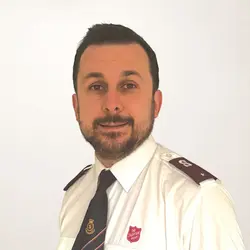
Captain James Pegg
Corps Leader, Feltham
Discover more

Ivan Radford encourages us to see the world through the lens of Jesus' enduring love and presence.


Territorial Whole-Life Discipleship Officer Major Michael Hutchings explores the assurance the Holy Spirit gives.