
4 July 2026
Acts 17: Children of light
Major Gordon Cotterill
Major Gordon Cotterill reminds us that in Christ we live and move and have our being.
Key text
- Acts 17:28
The theme of Together 26 – This Is Us – is an opportunity to explore together who are we – to reflect on where our being is found in Christ, where everything we are flows from and reflects Christ.
In Man of Prayer, American missionary to the Philippines, Frank Laubach, writes: ‘The simple program of Christ for winning the whole world is to make each person he touches magnetic enough with love to draw others.’ In this way, the call is not first to do, but primarily to be people whose lives are so deeply rooted in Christ that his love gently radiates from us and attracts people to him. This happens when we are shaped, sustained and renewed by the Holy Spirit.
In Ephesians 5:8–11, Paul writes: ‘For you were once darkness, but now you are light in the Lord. Live as children of light (for the fruit of the light consists in all goodness, righteousness and truth) and find out what pleases the Lord. Have nothing to do with the fruitless deeds of darkness, but rather expose them.’
Throughout the New Testament, we repeatedly encounter this kind of truth: in light or in darkness, setting our minds on heavenly or earthly things, the old and the new self, the spirit or the flesh, fruitful or unfruitful, in Christ or in the world. We are constantly confronted with this call to transformation – a life magnetic with the love and light of Christ. Here’s the thing: as Richard Rohr observes, we transmit the things that aren’t transformed.
Pause and reflect
- A magnet has the power to attract and repel. Which of your qualities are attractive and which are repellent?

Acts 17:28 speaks clearly: ‘In him we live and move and have our being.’ This shapes our whole essence. We are people whose nature is rooted in the presence of God. In him alone, we live and move and have our being.
Colossians 3:2 reminds us to set our minds on ‘things above’. Colossians 3:3 reminds us that we are ‘hidden with Christ in God’. As a consequence of Christ being our life, people will see Christ in us. This is us and this compels us to do what we do.
In 2 Corinthians 5:17, Paul writes: ‘Therefore, if anyone is in Christ, the new creation has come: the old has gone, the new is here!’
In the Roman world, identity was fundamentally corporate. People understood themselves located within a larger reality, such as a household, a lineage or a city. The ultimate measure of identity was as a subject of a ruler. To be a subject of Caesar was to participate in his story.
When, therefore, Paul writes about being ‘in Christ’ he’s not introducing a new metaphor but is reworking a familiar concept theologically. To be ‘in Christ’ is to belong to him, to share in his obedience, to share in his death, resurrection and vindication. This is where what is true of Christ becomes true of us. Because of who we are ‘in Christ’, we represent the good news of Christ. The announcement of Jesus that he had come to proclaim ‘good news to the poor’ (Luke 4:18) was a proclamation that a new reign had begun.
Pause and reflect
- Who or what defines who you are?
Roman coinage depicting Caesar often implied divine status. It is against this cultural backdrop that Jesus is proclaimed as the Son of God – the true good news. Jesus introduced a new reign – an alternative Kingdom, one that, when compared with the values of this world, is upside-down.
This is the essence, the glory and goodness, that was veiled from Moses as he hid his face from God (see Exodus 34:29–35). Such essence, glory and goodness became embodied, revealed in Jesus. In Colossians 1:15, Paul describes Jesus as ‘the image of the invisible God’.
When we are ‘in Christ’, Jesus is seen in – and through – us as compassion, kindness, humility, gentleness and patience, all united in love. It is a way of being that transforms us. As Paul in Colossians 1:27 says: ‘Christ in you, the hope of glory.’
The musical The Greatest Showman contains some memorable songs. One of them, ‘This Is Me’, is sung by a bearded lady, who has faced a life of ridicule and rejection. She sings: ‘I am who I’m meant to be … I make no apologies, this is me.’ What stirs my emotions is that, in a world that says ‘I love you if you’re good-looking, intelligent and have money’, this woman pushes back with the defiance of her true essence.
Pause and reflect
- How easily do you judge, dismiss or ignore other people because you perceive them as different?
Part of who we are is a quiet defiance to the ways of the world. In our very essence, we are children of light. Therefore, we have an outward focus. We’re called not to hide that light, but to let it shine so that others may see and give glory to God. This is what it means to seek what God wants. This is what it means to be energised by faith.
As children of light, we bear the light of Christ into the darkness of rejection, isolation, loneliness, exploitation, oppression and alienation. That is what we do because this is who we are in Christ. We are a magnetising people whose lives attract other people not to ourselves but to Jesus. With quiet confidence and holy defiance, we can say, not as a declaration of self-importance but as a declaration of God’s continual grace at work within us: this is us.
- Go deeper into the theme of This Is Us with a special five-part series of Sunday Worship. Listen to the podcast at salvationist.org.uk/sunday-worship.
Bible study by

Major Gordon Cotterill
Secretary for Spiritual Life Development, THQ
Discover more
Listen to This is Us from the Sunday Worship podcast – a podcast series exploring how God shapes who we are as individuals and as The Salvation Army.
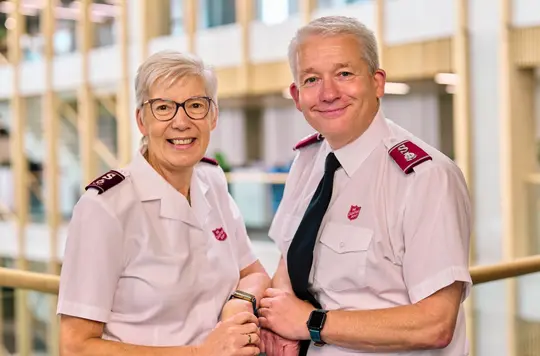
Commissioners Jenine and Paul Main encourage us to be part of the story as we celebrate who we are.

Territorial Whole-Life Discipleship Officer Captain Michael Hutchings talks to Ivan Radford about not letting insecurity or conformity conceal our God-given boldness.

Major Lynne Shaw asks what makes us who we are.