
15 August 2026
Psalm 105: Sing of his wonderful acts!
Major Graham Mizon
Major Graham Mizon encourages us to say thanks to God.
Key text
- Psalm 105
Was there nothing that David could not do? In his youth, he was a shepherd (see 1 Samuel 16:11). We famously know that he slew a giant with a pebble (see 1 Samuel 17:49 and 50), and that he became arguably the most successful military leader in biblical history (see 1 Samuel 18:5). He built a regional empire, established Jerusalem as a unified spiritual capital and paved the way for his son, Solomon, to build the first Temple in Jerusalem. He was also an extraordinary musician; he played the lyre (see 1 Samuel 16:18) and composed music. He even made bespoke instruments for his musicians (see 2 Chronicles 7:6). And if that wasn’t enough, God appointed this ‘man after his own heart’ (1 Samuel 13:14) king, reigning for a total of 40 years (see 2 Samuel 5:4 and 5).
Pause and reflect
- Whatever gifts and talents you may have, thank God for the ways he uses you in his service.
The book of Psalms, like the Pentateuch – the first five books of the Bible – before it, is divided into five books. Psalms 105 and 106 bring the fourth book to a close. They are a pair of historical hymns celebrating God’s deeds, especially reflecting on events recorded in the Pentateuch. While the author of Psalm 105 is not named, it is traditionally attributed to David. The first 15 verses are also found in 1 Chronicles 16:7–36, which is given the title ‘David’s Song of Thanksgiving’ in translations such as the New King James Version. It is a hymn that encourages people to remember God’s goodness and faithfulness over the years.
Pause and reflect
- Using a song, spend some moments praising God for his faithfulness and goodness, eg, ‘Forever’ or ‘Goodness of God’.

The song ‘Goodness of God’ includes the words: ‘All my life you have been faithful. All my life you have been so, so good.’ Psalm 105 goes on to say that the faithfulness and goodness of God are anchored in a covenant relationship that God has maintained with his people over many generations. In fact, the word ‘covenant’ is used consecutively in verses 8, 9 and 10. David states that, although this covenant was established through Abraham, Isaac and Jacob many generations ago, God ‘remembers his covenant for ever’ (v8).
This covenant line continues through Joseph, used by God to protect his people during a period of famine. Later, during four centuries of exile in Egypt, ‘the Lord made his people very fruitful; he made them too numerous for their foes’ (v24). The covenant was eventually ratified at Mount Sinai, also known as Mount Horeb, where God met with Moses.
The fifth book of the Pentateuch is Deuteronomy. Rather than a standard narrative, it is essentially a collection of three sermons delivered on Mount Nebo by Moses to a new generation of God’s people. They were about to enter the Promised Land after 40 years of wandering in the wilderness. After sitting through three long sermons, you might expect the congregation to die.
On this occasion it was the preacher who breathed his last! He was 120 years old.
Moses’ first sermon focused heavily on the past. He urged this new generation to remember that they were a continuation of the covenantal line, especially since most of the previous generation had died in the wilderness (see Numbers 26:63–65). Repeatedly, Moses told them to ‘remember well what the Lord your God did’ (Deuteronomy 7:18).
Pause and reflect
- Deuteronomy 6:4–9 contain a daily Jewish prayer called the Shema. Reflect on the teaching that ‘these commandments that I give you today are to be on your hearts’ (v6) and that you should ‘impress them on your children’ (v7).
- In what ways can we ensure God’s words are on our hearts so we can live them out?
- In what ways can we ensure God’s words are on our lips so we can share them with the next generation?
When referring to God’s people, the word ‘righteous’ or ‘righteousness’ is found approximately 140 times in the Psalms alone. For example, ‘the righteous will rejoice in the Lord and take refuge in him’ (Psalm 64:10). The concept of righteousness implies being in a right relationship. It’s a powerful reminder that a covenant is a relational bond. God and his people are in a relationship that began with Abraham and continues through the generations.
This covenantal line finds its fulfilment in Jesus, as foretold in Jeremiah 31:31–34. Paul writes in Romans 10:3 of the Israelites: ‘They were ignorant, you see, of God’s covenant faithfulness, and they were trying to establish a covenant status of their own’ (New Testament for Everyone). Yet, because we are in Christ Jesus, we can rejoice that nothing can separate us from the love of God that is in Christ Jesus (see Romans 8:39).
Pause and reflect
- Meditate on Philippians 3:7–11 and consider Paul’s plea that, in knowing Christ Jesus, we receive a ‘righteousness that comes from God’ (v9 Good News Translation).
Psalms 104, 105 and 106 are a trilogy of psalms that all begin and end with a variant on ‘praise the Lord’, or ‘hallelujah’ in Hebrew. Because of this, Psalm 105 effectively begins and ends with a hallelujah – a joyful note on which to conclude our Bible study!
Pause and reflect
- Consider the spiritual and wellbeing benefits of beginning and ending your day by thanking God. What will you thank God for at the end of this day?
Bible study by
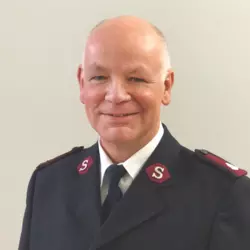
Major Graham Mizon
Discover more

Lara Fadahunsi (Liverpool Stoneycroft) testifies that she is saved not by works but by grace.

Captain Marie Karičková believes God is worthy of our trust, even in the hardest times.
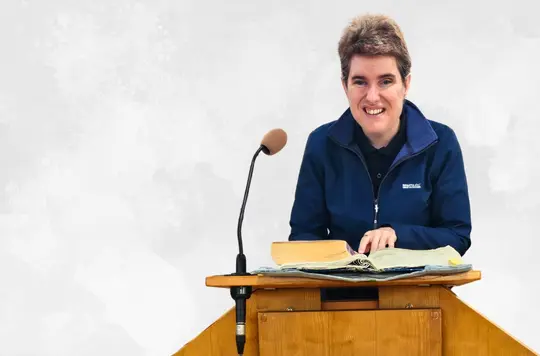
Vicki Manley (Hereford) thanks God for an inclusive corps community that encouraged her to follow a calling.