6 December 2025
Help shape The Salvation Army's response to domestic abuse
Amy Quinn-Graham

Amy Quinn-Graham (Research and Development Unit) invites people to be part of the solution to tackling domestic abuse.
Three years of studying domestic abuse across The Salvation Army has taught me a lot. First, people across the Movement care deeply about responding well to domestic abuse. They want a Movement that is safe for survivors, where perpetrators are both held to account but also supported to recognise their harmful behaviour and repent. Second, I’ve learnt that domestic abuse is a reality for many across the Movement. More than half (59 per cent) of people who completed an initial survey indicated that they had experienced, or were experiencing, domestic abuse. While the survey was self-selecting, so this figure is likely higher than the reality, it tells us that domestic abuse is happening in corps, contracted services and across the communities The Salvation Army works in.
Only 29 per cent of survey respondents who had experienced domestic abuse chose to disclose their abuse to someone within The Salvation Army. Of those who disclosed, 41 per cent received a negative response. Of those who chose not to disclose, 71 per cent described silence and denial as a barrier: they feared that the person they would have disclosed to wouldn’t be adequately equipped to handle their disclosure, or that confidentiality would be broken. However, those fears might not have been borne out: nearly half of those who disclosed received a helpful response, so there is good work to learn from.
This next phase of my research is an opportunity for me to explore this in more depth. I will be conducting participatory action research (PAR) with survivors and with corps leaders. PAR is a way of doing research that empowers people to play an active and influential role in decisions that affect their lives. Participants become ‘co-researchers’, sharing their experiences, working together to identify common themes and using this knowledge to shape the direction of the research, ultimately leading to action and positive change.
This is where I need you! I am looking for survivors of domestic abuse from across The Salvation Army who are interested in coming together – either online or in-person – to share their experiences and shape the future of the Movement’s response to domestic abuse. I am also looking for corps leaders who are interested in exploring how they have responded, or might respond in the future, to domestic abuse. Of course, being a survivor of domestic abuse and being a corps leader isn’t mutually exclusive, so, if you’re a corps leader who’s experienced domestic abuse and you’re interested in being involved, it would be up to you how you participate.
Kristin Aune and Rebecca Barnes’s groundbreaking 2018 study into domestic abuse among churchgoers in north England revealed that only two in seven churchgoers consider their church adequately equipped to handle a domestic abuse disclosure well. We know from other research that church leaders often feel nervous and ill-equipped to recognise domestic abuse, assess risk levels and respond appropriately while also offering spiritual and/or pastoral care. If that’s you, you’re not alone. Confronting domestic abuse is always challenging. Nevertheless, Scripture encourages us to be brave, using the power we have received through the Holy Spirit, and the love we have for each other, to challenge this injustice: ‘For the Spirit God gave us does not make us timid, but gives us power, love and self-discipline’ (2 Timothy 1:7).
The research would comprise approximately four two-hour sessions over the next year. If you’re interested in exploring responses to domestic abuse within The Salvation Army, to better equip the Movement to respond to domestic abuse safely and effectively, please get in touch. I would love to hear from you.
- To ask questions, find out more or express your interest, email amy.quinn-graham@salvationarmy.org.uk or praqg@leeds.ac.uk.
Written by

Amy Quinn-Graham
PhD Researcher, University of Leeds
Discover more
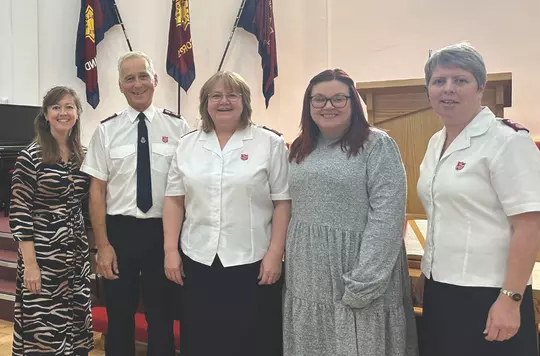
Major David Betteridge shares an update on research within The Salvation Army.
Enabling corps and local expressions to support victims of domestic abuse and set up a Beacon Church.
Lieutenant Amanda Sewell (Thorndale Family Centre) tells Salvationist about new domestic abuse training in the Ireland Division.