
24 January 2026
Stephen Cobb: ‘It’s about people more than pieces’
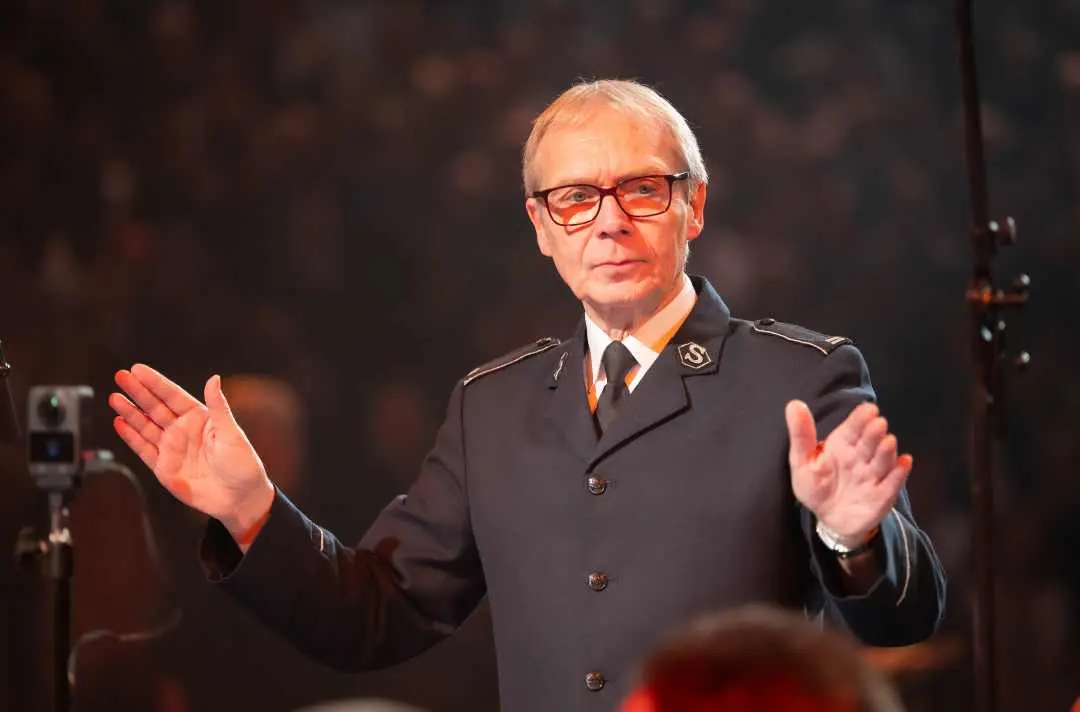
International Staff Bandmaster Dr Stephen Cobb talks to Salvationist about 50 years of service with the ISB.
This weekend at Regent Hall, a series of events celebrates the music, ministry and leadership of Dr Stephen Cobb, who has led the International Staff Band since April 1994 and played in the band since 1975. As he prepares to retire from the role of bandmaster, he looks back at five decades of service.
You’ve been the International Staff Bandmaster for more than 30 years. Is that something you ever expected?
No. I was the first non-officer to be appointed International Staff Bandmaster. It’s been a real privilege and I’ve never lost sight of that.
I was actually going to leave the ISB in 1994. I spoke to the then bandmaster, Colonel Robert Redhead, about it in 1993. I had been the principal cornet for 15 years, I was bandmaster at Hendon Corps, I had just finished my first degree and had two young children. I was unhappy with my playing and I spoke to Robert about withdrawing from principal cornet. The plan was to support the band for a further year and then withdraw.
But by November of that year, Robert received a change of appointment, an announcement that he made to the band around Christmastime. I had no expectation of becoming the bandmaster because it was an officer appointment, so I gave it no thought.
So it was a surprise to be invited to see the then territorial commander, Commissioner Dinsdale Pender. He asked me to take it on and I agreed.
When I joined the band, my plan was to play in it for five years. Those five years were up just after a five-week tour we’d undertaken. And it just went on and on. It has never felt anything like the number of years it was along the way!
How are you feeling about retirement?
I was territorial music director for the UK and Ireland Territory for 24 years and with every passing year work seemed more than that, it felt more like ministry. I left that role in May 2025 with a sense that it was the right time to retire.
I’m not sure what my retirement from the International Staff Band will be like. I’m still in awe of the band. There is still a feeling on a Wednesday evening of nervousness and excitement. I always said to myself that the week I didn’t feel this way would be the week that I would finish. There will be those who will wonder what I’m going to with myself now, which is of course a question I ask myself too! But I’m sure there will be things for me to do. I can’t lie, though: I think this weekend could be tricky!
Your dad, Roland Cobb, was in the ISB for more than 18 years. How did you start playing and how did he influence you?
My dad was such a legend as a cornet player that, in some ways, it was the last instrument my brother and I should have landed on. We both did! I can’t say my dad pushed me into playing the cornet, but I liked doing it. I also liked being in a group – I’m a shy person, and I could get lost in a group quite easily.
My dad was in the band and he was away a lot – we were very proud that he was in the band and, when the band were in town, we used to go and listen. The adjustment for him when he left the ISB was tough. He would never admit it, but I think he missed the band and what the band gave him as well as what he gave the group.
We were an Army family and it could be very exciting – people would come to the corps because Roland Cobb was there! Growing up as a teenager, and going to territorial music schools, there could sometimes be a bit of pressure because of my surname. That wasn’t always easy, but what I learnt was that you have to be yourself.
What was it like when you first joined the ISB in 1975?
I joined the ISB straight out of college and it was a band full of good people, mature Salvationists. They taught me so much, often without saying anything. Lieut-Colonel Ray Bowes was the newly appointed conductor of the band, and it was a time of readjustment for the band. I came in right at the beginning of Ray’s tenure. The band at that time almost exclusively comprised officers and Salvation Army employees. We rehearsed three lunchtimes a week and on Wednesday evenings. In addition to that, we had an annual day with the General at Westminster Central Hall, and a Thursday evening at William Booth College. It was very much a band associated with International Headquarters. I think I was one of five or six non-officer, non-employee members at that time.
What recollections do you have of your predecessors?
Ray was a lovely man and a beautiful Christian gentleman, as well as being an outstanding musician. Robert had a different approach. He changed the repertoire and approach of the band. Contemporary worship songs were beginning to be used within The Salvation Army and Robert incorporated them into the ministry of the band. Robert, too, was a gentle man, but was not afraid to make difficult decisions. While his tenure was not particularly long, his contribution to the life of the ISB and its ministry is inestimable. Robert was a really good role model for me and I will always be in his debt.
Different bandmasters bring different qualities to the role. How would you describe your leadership?
I don’t know – I feel that’s for other people to say! What would I like people to think about my leadership? That I respected the history and the heritage of the band. That I was committed to the mission of music through the ISB, and that it was still relevant to the Army of now. That I respected the fact that the ISB has this incredible capacity to reinvent itself. That I did my best. I think people can be scared of the word ‘excellence’ when it comes to music, but we shouldn’t be afraid to bring our best selves to our ministry.
Has your approach changed over the years?
I think it probably has. I think I had an idea of how a staff bandmaster should be. I’ve always been myself, but I think in the day-to-day management, I kept my distance a little. During the Covid-19 pandemic, we met weekly on Zoom as a band. It was important to the fellowship of the band that we did that. During that time and the phone calls I made around the band each week, what I learnt was, to my detriment and the band’s detriment, the relational element had been missing previously to some degree. So I would say that I’ve become a more relational bandmaster. But of course the band might have a different view!
Can you remember the first rehearsal after the pandemic?
The first rehearsal after the Covid-19 lockdowns was absolutely amazing. To see the band making their way up the stairs to play with such enthusiasm was wonderful. I can’t remember what we played to start with, but it was very emotional!
Out of the managing, the conducting, the playing, has there ever been a part that’s been most rewarding?
People often ask me about my favourite pieces, but the truth is that it’s about people more than pieces. The people I’ve been in the band with along the way are the highlight.
Perhaps one of the most rewarding aspects is being part of worship on a Sunday morning and doing pre-meeting music. Pre-meeting music wasn’t a handed-down thing, and we’ve worked hard on that. For corps weekend visits, one of my focuses was to make the Sunday – the meeting, the afternoon programme – at least as good as the Saturday festival. As well as our ministry to the corps we’ve visited, my sense is that it’s also been a ministry to the band members themselves: we have 14 or 15 members of the band who are themselves music leaders and this ministry is meaningful to them too, as they go back to their corps.
If you were talking to someone who’s never heard a brass band before, what pieces would you play them?
In recent years, a piece like Geoffrey Nobes’s ‘Prelude on “Lavenham”’ has been really powerful. It’s a beautiful hymn tune, with strong words that talk about life, but it also expresses what a band could sound like and the value of a band and the value of word association with music.
If I were talking to a music enthusiast and wanted them to understand a more sophisticated aspect of Salvation Army brass band music, I would point them in the direction of Leslie Condon’s ‘The Present Age’ – it is a really sound example of telling a story. It was written in 1968 and it’s still relevant today. Les was one of my heroes.
Eric Ball’s ‘The Kingdom Triumphant’ is also a wonderful example of telling a story through music.
Has it been exciting to come across new composers or see composers develop?
It’s a privilege for the band to look at new pieces of music, quite often from new composers, and, over a period of time, witness their development through their music. For example, Marcus Venables has faithfully sent music across from Canada and it has been such a joy to see his development. One of his latest pieces is ‘Holy Forever’, music that, when we first played it, we knew was going to have a great impact.
Is there a Bible verse or song that has kept you going in the focus of why you do what you do?
Psalm 23 is probably the first piece of Scripture that I learnt as a young soldier. The translation ‘the Lord is my Shepherd; I have all that I need’ (Psalm 23:1 New Living Translation) stays with me regularly, reminding me that every day is a gift from God. I don’t know whether it’s me getting old, but I find myself using the word ‘blessing’ a lot! Another verse is ‘in all thy ways acknowledge him, and he shall direct thy paths’ (Proverbs 3:6 King James Version).
In terms of songs, during the early days of my tenure as bandmaster, the then executive officer Colonel Trevor Davis would introduce a new worship song when we visited a corps. One of the first we played was ‘Knowing You’. Even now, when I revisit that, it speaks to me very powerfully.
Throughout your time with the ISB, you’ve also played in, and been bandmaster of, Hendon Band. How important has that been to you?
This is really dear to my heart. For me, The Salvation Army has always been about being committed to one’s local corps or centre. To every potential member of the band at audition, it is made clear that this is not instead of service, this is extra-mile service. I understand that there’s a big picture too but, for me, what we contribute to ministry in our local corps is very important. I would like to think people at my corps would feel that I have always been committed there as well as with the ISB.
What role do music and brass bands play in mission today?
I think we perhaps have the best mission opportunity we’ve ever had as musicians to bring people to church through music. Today, bands can be one of the most inclusive groups we have in The Salvation Army: we are not necessarily bound by regulations or uniform, we can just invite people along to share this very special gift. That’s really exciting!
There are already corps with community and learner bands who are examples of this level of inclusion, and people are finding faith through this avenue. My belief that music can make a difference to the life of The Salvation Army is undiminished.
- A recording of SC50: A Tribute to 50 Years’ Service in the ISB will be available to stream on wobplay.com.
Discover more
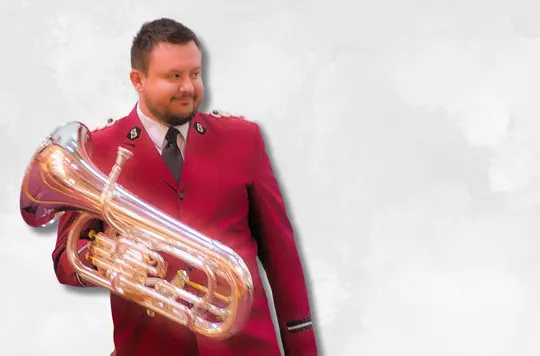
International Staff Bandsman Andrew Hedley (Chester-le-Street) testifies that God is in control and he is along for the ride.
Stephen Cobb, director of music and creative arts and bandmaster of the International Staff Band, shares his story and song.
As the International Staff Band launch their latest album in their heritage series, Matthew Frost talks with Dr Stephen Cobb, Andrew Blyth and Kevin Norbury about brass band music from the 2000s.
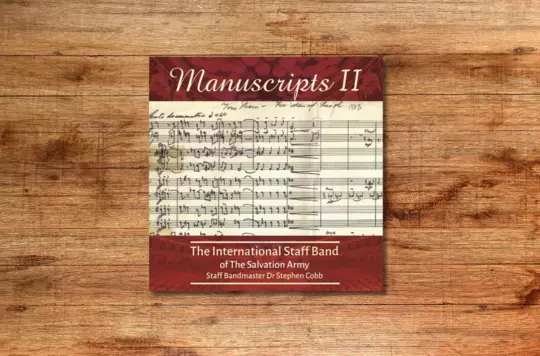
Charlie Green (Droitwich Spa) reviews the ISB album Manuscripts II.