18 July 2026
1 Peter 1: Set your hope on Jesus
Major Jennifer Gosling
Major Jennifer Gosling reminds us that doing for God flows out of being with God.
Key text
- 1 Peter 1:13–22
Have you ever stripped your bed in the morning – daydreaming about the lovely moment later on when you get to sink into freshly laundered sheets – only to discover upon crawling back at a very late hour that you forgot to make it again? It’s a life lesson many of us have learnt: to make good choices in the present, in the light of a future hope and joy.
Peter’s first letter addresses a scattered Christian population that is encountering suffering and difficulty. He tells them to set their hope on Jesus and his return, to make good choices and, in the light of this future hope, to live a holy life now. This is what 1 Peter is all about. And, while there is an element of instruction to it, it is as much an invitation to a way of life that is shaped by Jesus. The Greek word used here for ‘hope’ is elpizō. It is not a ‘wishes and dreams’ kind of hope; instead, it refers to a strong and confident expectation that God can be trusted to keep his word, which is enough to influence the way we act.
Pause and reflect
- Is your hope in Jesus a strong and confident expectation?
- How does this shape the way you live your life now?
Our study passage begins with ‘therefore’, so it is important we consider what the ‘therefore’ is there for. In the opening of the letter, Peter reminds the reader that they are ‘chosen’, recipients of ‘new birth into a living hope’, assured of a heavenly ‘inheritance’ and ‘shielded by God’s power’ and have received the salvation of their souls (1 Peter 1:2–9). What a hope and a gift!
Peter says: ‘Therefore … set your hope … on Jesus… So be holy in all you do’ (vv13–15). Live your life with this future hope in mind. Living a holy life is a response to God’s redemption and salvation; our hope impacts our holiness.
Pause and reflect
- What are your thoughts and beliefs about holiness?
- What do you feel about the command to ‘be holy, because I am holy’, which was given in Leviticus 19:2?

Our holiness is rooted in the holiness of God the Father as people made in his image, in our identity in Christ. It is worked out in us through the power of the Holy Spirit. Principally, holiness is not the result of our own efforts. Instead, it flows out of our relationship with a holy God whose character we aim to reflect. We are holy because we walk closely with God, not because we work for God. The ‘doing for God’ flows out of the ‘being with God’. In his book Practicing the Way, John Mark Comer advocates that we: ‘Be with Jesus; become like him; do as he did.’
Peter frames his letter in familial terms, where we are God’s ‘obedient children’ (v14) and he is our just and impartial Father (see v17). In this context, the greatest compliment we could receive is for someone to tell us: ‘You are just like your Father!’
However, Peter also alerts us to ‘the empty way of life handed down to you from your ancestors’, and that we can no longer be redeemed by the old ways, through silver or gold, but only through the blood of Jesus (see vv18 and 19).
There is a story of a man who always sliced the ends off a joint of beef before roasting it in the oven. One day his mum came for a meal and asked why he did that. The man responded, saying that this was what he watched her do every time she roasted beef, so now he does it too. His mum informed him that she cut the ends off her beef because it didn’t fit in her roasting tin!
Pause and reflect
- Do you have any inherited patterns, behaviours or attitudes that do not serve a helpful purpose? Do they hinder your walk with God?
- Are there generational cycles that are more of this world than of the next?
- Do they therefore need to be broken and redeemed?
It is the Holy Spirit who brings about our transformation. However, we also have a part to play by having ‘minds that are alert and fully sober’ (v13). This means not allowing anything to infiltrate our thought life that causes us to be careless in our thinking or prevents us from making healthy judgements about how we live. ‘Gird up the loins of your mind’ is how the King James Version expresses this. This is about preparation, intentionality and readiness for action.
Joan of Arc is attributed with saying: ‘All battles are first won or lost in the mind.’ Holiness is a choice we make, moment by moment, and Peter says to ‘live out your time … in reverent fear’ (v17). This is not about living in fear, rather about taking our relationship with God seriously. The Salvation Army’s ninth doctrine states: ‘We believe that continuance in a state of salvation depends upon continued obedient faith in Christ.’ This is made possible through ‘regeneration by the Holy Spirit’, as outlined in doctrine seven.
Pause and reflect
- If you were to reflect on your physical, emotional, spiritual and thought life, and consider this in the light of Christ’s return, what one specific change could you make this week?
Perhaps you would like to pray this prayer from ‘Gracious Spirit, Dwell With Me’ (SASB 300): ‘Holy Spirit, dwell with me; I myself would holy be, separate from sin, I would choose and cherish all things good; and whatever I can be give to him who gave me thee.’
Bible study by
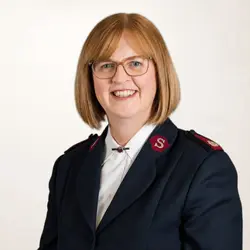
Major Jennifer Gosling
Learning and Development Support Officer, William Booth College
Discover more

Ivan Radford encourages us to see the world through the lens of Jesus' enduring love and presence.

Major Graham Mizon reminds us that Jesus is the one who invites us, unites us and holds us together.