
31 January 2026
Mark 12: Sacrificial giving
Polly Hughes
Polly Hughes celebrates the power of generosity.
Key texts
Jesus lived within a deeply patriarchal, male-dominant culture, where widows were some of the most vulnerable people in society. They had little protection, often no income and were on the fringes of society.
Meanwhile, Jesus describes scribes as those ‘who devour widows’ houses’ (Mark 12:40). Instead of helping widows in need, these religious leaders were content to rob them.
The widow’s actions in our study passage illustrate how we should give. The greedy practices of the scribes are contrasted with her beautiful sacrifice.
Jesus uses her example to challenge the injustices of the day.
Pause and reflect
- What injustices can we identify in our society?
- How might God be calling us to live differently?

In the Temple, the treasuries used for collecting offerings were trumpet-shaped chests, known as shofarot – ‘trumpets’ in Hebrew. Their shape would amplify, for all to hear, the sound of coins being dropped in. Jesus and other bystanders would have been able to hear and see what people were giving.
In Mark 12:42, the widow offers all she has, the equivalent of less than a day’s wages. Just a couple of coins wouldn’t have made a lot of noise. It was a small yet significant offering. In Greek, the phrase used in Mark 12:44 is ‘holon ton bion’ – meaning her whole life. She put her everything – her ability to eat or pay for shelter – into God’s hands. That’s a level of trust that inspires me. I am also intrigued about what caused her to make such a decision.
In the Ignatian tradition, there is a principle known as consolation, defined by Ignatius as: ‘An interior movement of the soul, through which the soul comes to be inflamed with love of its Creator and Lord.’
Anthropologist Helen Fisher studied the brains of those in love. Her research used functional MRI images to describe what happens to a brain in love. Three areas light up: the pleasure area, the risk area and an area associated with connection.
The widow’s choice to give was risky. However, when in love, science shows that we are willing to be vulnerable out of a desire for a deeper connection. Doing so gives us pleasure.
The material value of our gift is far less relevant than the strength of our relationship with God, and science backs this up. Our giving must first and foremost be from a place of love for him.
Pause and reflect
- What are you willing to risk for a deeper connection with God?
In Mark 12:43, Jesus acknowledges the value of the widow’s sacrifice. His teaching highlights that it’s not about giving out of wealth. Some of the most generous people in my life have the least wealth. Several years ago, I lived in South Sudan, civil war had broken out and famine was a constant threat. One community I visited had just three months’ supply of food left due to the war limiting their ability to grow crops.
When a fresh wave of fighting broke out in a neighbouring area, it displaced hundreds of people fleeing for safety. The community welcomed them into their homes without hesitation, sharing their limited supplies despite it bringing the risk of famine much closer. It was a beautiful illustration of God’s love in action and a testament to their trust in his future provision, much like the widow in this passage.
I am challenged by both examples to consider whether I would really do the same. In one of Timothy Keller’s sermons, Generosity in Scarcity, he writes: ‘When God’s grace truly liberates you, so that you’re able to give, then your money becomes a form of God’s grace.’ He adds: ‘Your money keeps ministries going, which liberates people spiritually, and your money helps the poor … which liberates people physically… It’ll become a vehicle for God’s grace.’
Pause and reflect
- Do you feel liberated by God’s grace?
- How might your sacrificial giving become a vehicle for God’s grace?
Mark 12:44 reminds us that we are called to give freely and cheerfully. We must give, not out of a place of material wealth, but out of a deep understanding of his grace and the abundance of his love – whether it’s donating to a cause, mentoring someone or simply offering a kind word.
Giving isn’t just good for others – it’s powerful for our brains too! Science shows that acts of generosity rewire our brains for greater happiness, lower stress and longer, healthier lives. It might be the key to unlocking our fullest potential. It triggers the same parts of the brain associated with joy and satisfaction.
This phenomenon is called the ‘helper’s high’, making us more likely to continue helping others.
Generosity strengthens social bonds through oxytocin – often called the ‘love hormone’ or ‘bonding chemical’. It increases trust, empathy and emotional warmth, leading to stronger relationships, better communication and a greater sense of belonging.
One of the most surprising benefits of generosity is its ability to reduce cortisol, often called the ‘stress hormone’. Acts of kindness buffer the brain against stress, promoting a sense of calm and emotional resilience.
When you give, your brain builds and strengthens neural pathways associated with empathy, compassion and emotional intelligence. Knowing your actions are making a positive impact, your brain releases serotonin, which can help combat depression, increase motivation and make you more mentally resilient in the face of challenges.
Giving isn’t just a moral or social responsibility – it’s a brain-boosting superpower. Thanks to Jesus, we are still talking about two coins given by a widow thousands of years ago. Just imagine what he could do with an army of people giving sacrificially because they were liberated by God’s grace and motivated by love.
Bible study by

Polly Hughes
Directer of Fundraising, THQ
Discover more
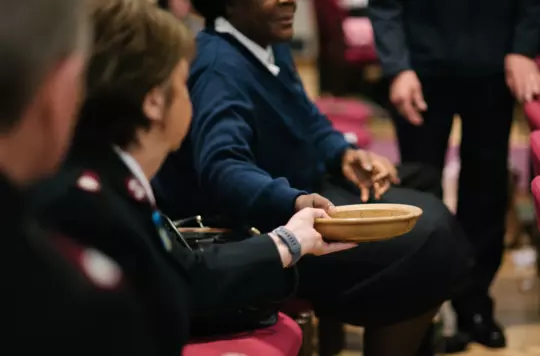

Six Bible studies based on Psalm 100:1-5 which help explore the theme of Generous Discipleship.
Use event fundraising to help deliver mission objectives and connect with people in your local area.