
28 February 2026
Mark 14: The impact of silence
Lieut-Colonel Nick Coke
Lieut-Colonel Nick Coke reflects on the example of Jesus before the Sanhedrin.
Key texts
Knowing when to speak and when to bite your tongue is an age-old conundrum. Over the years, I’ve asked myself: ‘Should I say something?’ Sometimes, I’ve missed the moment and regretted not being bold enough. Other times, my words have come back to haunt me.
It is one thing to think about this in a personal capacity, but it is also relevant to speaking in the public square. As secretary for communications, I’m acutely aware of The Salvation Army’s public voice. Making decisions about when to speak and when to stay quiet is a daily, hour by hour, part of our work in the Communications Service.
To add to the complexity, it’s never been easier to share opinions publicly than it is now, thanks to the digital world we live in. Social media has revolutionised this aspect of our lives, and we’re all aware of problems that have emerged. Toxic environments in the online space are common. Even opting out and saying nothing can be taken as a sign of apathy towards social and political issues.
Pause and reflect
- How do you decide when to speak and when to remain silent?
- How is this reflected in how you speak in public and private?
In our study passage, we encounter Jesus in the hours leading up to the Crucifixion. Following his arrest in the garden of Gethsemane, he is brought before the Sanhedrin – the supreme council in ancient Israel, made up of the key religious leaders who governed internal Jewish affairs in Jerusalem. We discover Jesus alone, late at night, standing before his accusers. Mark narrates how Jesus’ followers fell away, with only Peter remaining outside in the courtyard (see v54). Whatever happens from here on in, Jesus will need to do it alone.
Pause and reflect
- Use your imagination and put yourself in the shoes of a council member or Peter or Jesus in this moment.
- What can you see and hear?
- What feelings arise in you?

In this hastily convened trial of sorts, we are told that various false allegations are made against Jesus (see vv56–59) as the religious leaders attempt to expose him on the charge of blasphemy. In the face of this onslaught, Jesus chooses to remain silent. Even when the high priest directly asks him for a response, Jesus says nothing (see vv60 and 61). How should we interpret this?
Some biblical scholars point to this moment as a fulfilment of Isaiah’s prophecy about the Messiah: ‘He was oppressed and afflicted, yet he did not open his mouth; he was led like a lamb to the slaughter, and as a sheep before its shearers is silent, so he did not open his mouth’ (Isaiah 53:7). Others have pointed out that, in Old Testament wisdom, silence is a sign of dignity and restraint in the face of adversity (see Proverbs 17:28).
It could be argued that Jesus’ silence says more than any number of words could convey. His refusal to speak exposes the corruption of the court with all its false words. It also allows him to keep a measure of control on the proceedings.
Pause and reflect
- Can you think of a time when silence impacted on a particular situation?
- What message did it convey in that moment?
A point of high drama arrives as the story reaches its climax. The high priest asks Jesus directly if he is the Messiah (see v61). This time, Jesus breaks his silence with a clear and powerful statement: ‘I am… And you will see the Son of Man sitting at the right hand of the Mighty One and coming in the clouds of Heaven’ (v62). Jesus’ refusal to speak before now has built anticipation for exactly this moment. His words, when they finally arrive, are designed to have the maximum effect. They must have cut through the room like a knife. Now everyone is listening!
In my mind’s eye, I see the shock on people’s faces, followed by an audible outpouring of fury and dismay. The high priest tears his priestly robes as a signal of his outrage at Jesus’ words.
Pause and reflect
- How has Jesus’ silence given impact to the declaration that he is the Messiah?
- What lessons might we learn from this story about the impact of words and their timing?
In the final verses of our study passage, Jesus is spat on, blindfolded and beaten. Council members taunt him, suggesting that he is such a useless prophet that he can’t even say who has just hit him. The irony exposed by Mark is that it is not Jesus who is being blind here, but rather the religious leaders who fail to recognise the Messiah and the prophetic revelation of truth that is staring them in the face.
Pause and reflect
- How do you discern prophetic truth?
- Consider what might prevent you from recognising Jesus in all his glory.
- What simple steps could you take to better discern what God is saying to you?
This story is a deeply disturbing one. Even though we hear it every Holy Week, its power is not diminished by familiarity. In Mark’s Gospel it forms part of the narrative about what happened to Jesus in his final hours. It also demonstrates the extraordinary way Jesus behaved in the face of violence and suffering.
Today, corruption, injustice and misuse of power are still very present in our world. At some time, we will all encounter it to a greater or lesser degree. As we reflect on this story, may the power of Jesus’ example infiltrate our hearts and minds and guide us how to live as his followers.
Bible study by
Lieut-Colonel Nick Coke
Secretary for Communications, THQ
Discover more

Captain Ben Ellis encourages us to remember how faithful Jesus is to us.

Major Paul Knight explores how a choice in Gethsemane benefits all who believe.
A 40-day Bible reading plan with 40 song lyrics for reflection and a Bible reading for each day, alongside a page for your own journaling.
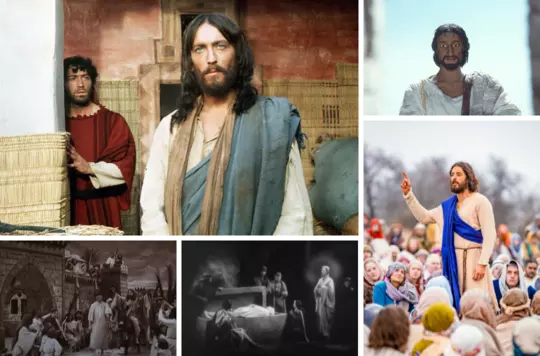
Ivan Radford explores portrayals of Jesus and the events of Easter on film and TV.