
21 March 2026
Mark 15: He can't save himself!
Captain Shawn Moye
Captain Shawn Moye considers the abuse hurled at Jesus.
Key texts
- Mark 15:16-32
‘Sticks and stones may break my bones, but words will never harm me.’ For some of us, these words will conjure up images of times when we were encouraged to be resilient and ignore hurtful words. That is easier said than done!
Pete Doherty sang a variation of this saying with his band, Babyshambles, which I am not recommending but believe is closer to the truth: ‘Well sticks and stones/ May break my bones/ Oh but your words, oh they really hurt me.’
Pause and reflect
- Have you ever been hurt because of people’s words?
- How did you react or respond?
Jesus certainly had plenty of words thrown at him. Words of praise and worship as he entered Jerusalem (see Mark 11:9 and 10). Words to question as the chief priests and the teachers of the Law challenged his authority (see Mark 11:28). Words to trap by asking about paying taxes (see Mark 12:14). Words to mock when the Roman soldiers beat and paraded him as, in their eyes, a false king (see Mark 15:18).
Pause and reflect
- How aware are you of the words that you use, especially in heated and threatening moments?
It is important not to lose the horror of what Jesus was put through. Mel Gibson’s The Passion of the Christ was heavily criticised for many reasons, including the graphic violence shown. It does remind us, however, of the brutality that Jesus faced and how it physically weakened him, making it difficult to carry the cross to Golgotha.

We see Simon of Cyrene forced to step in and carry the cross. I wonder what words might have been spoken between Simon and Jesus. Scripture does not record any, but I would like to imagine that they made an impact on Simon’s life.
Pause and reflect
- Words have the power to heal as well as destroy.
- When might you need to hear words of healing for yourself, and the situations you find yourself in?
- Let Jesus whisper words that heal, and allow his love to free you from the hurts of your past.
As Jesus is lifted onto the cross, those who pass by hurl more words of insult and mockery, and shake their heads, too. These words echo Psalm 22:7: ‘All who see me mock me; they hurl insults, shaking their heads.’
In our study passage, Mark continues to create imagery of the abuse hurled towards the Righteous One by including words that were spoken earlier – in Mark 14:58 – by false witnesses: ‘So! You who are going to destroy the Temple and build it in three days, come down from the cross and save yourself!’ (vv29 and 30). The intention was to discredit what had been said about Jesus and to take away his authority – if you can’t save yourself, how are you going to destroy the Temple!
It is not surprising that those passing by and those who gathered around the crucifixion scene were uttering words of abuse as they witnessed their religious leaders doing the same. We read: ‘In the same way the chief priests and the teachers of the Law mocked him among themselves. “He saved others,” they said, “but he can’t save himself!”’ (v31). To utter those words, they must have really hated Jesus. How sad that they misunderstood what was truly happening.
Pause and reflect
- Whether formalised or not, we all have influence and responsibility.
- Are you aware how others might replicate what they see or hear you do and say?
In that place of ridicule and abuse, something truly wonderful was happening. It’s something that completely bypasses those who were hurling insults. The truth of the matter is that Jesus was not able to come down from the cross and save himself because he had to stay there so that humanity could be saved. Kent Brower, in his commentary on Mark, summarises it perfectly: ‘Mark’s readers know that it is precisely by staying on the cross that Jesus exercises ultimate authority, serves others, and re-creates the new covenant people of God.’
The wonder of the situation is that love wins, as Kathryn Scott encapsulates in her song ‘At the Foot of the Cross (Ashes to Beauty)’:
At the foot of the cross,
Where grace and suffering meet
You have shown me your love
Through the judgement you received.
Jesus absorbed the words of hate and ridicule. He did not retaliate but uttered words of forgiveness (see Luke 23:34) and those words of forgiveness are extended to each one of us. The place of torture becomes a place of healing and through his death we are made whole.
Kathryn Scott continues in her song:
At the foot of the cross
Where I am made complete
You have given me life
Through the death you bore for me.
Not all words at the cross were abusive. When Jesus died, the centurion stated: ‘Surely this man was the Son of God!’ (v39). We can be grateful that Jesus didn’t save himself but that he saved us and made us whole.
Pause and reflect
- Pray this prayer from Amy Boucher Pye’s The Living Cross: ‘Lord Jesus Christ, Son of the living God, have mercy on me, a sinner. May my life reflect your forgiveness; may I extend your grace and mercy to those who wrong me; may I seek your cleansing when I turn from you. Come, Lord Jesus, and fill me afresh with your peace as I thank you for your sacrifice of love.’
Bible study by
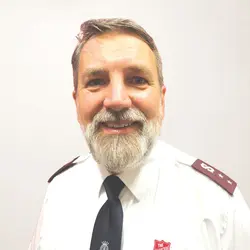
Captain Shawn Moye
Corps Leader, Stepney and Poplar
Discover more


Lieutenant Joel Watson considers how fear and failure do not need to define us.

Lieut-Colonel Nick Coke reflects on the example of Jesus before the Sanhedrin.

Major Paul Knight explores how a choice in Gethsemane benefits all who believe.