
7 November 2026
Psalm 143: Unfailing love
Major Kingsley Layton
Major Kingsley Layton considers the meaning of sacrifice.
Key text
Pursued, crushed, faint, dismayed, failing, parched – none of these words that David employed in Psalm 143 needs explaining.
Let me share with you a true story. Captain Charles Upham was a soldier in the New Zealand military who earned the Victoria Cross twice during the Second World War. Only three people have received the Victoria Cross twice; Upham is often described as the most highly decorated Commonwealth soldier of that war.
On the night of 14 July 1942, Captain Upham was commanding a company in Egypt. He was wounded twice, once when inspecting his forward sections guarding minefields and again when he destroyed a truck carrying German soldiers using grenades.
Just before dawn, the reserve battalion encountered four machine gun posts and a number of tanks. Upham led an attack on the two nearest strongpoints. His voice could be heard above the din, cheering on his men and, in spite of the resistance and casualties on both sides, the objective was captured. Although he was shot through the elbow and had his arm broken, he went on to a forward position and brought back some of his men who had become isolated.
Weak from loss of blood, he was sent to the regimental aid post, but once his wound was dressed he immediately returned to his men, until he was wounded again and captured.
Let’s pause here. Captain Upham didn’t seem to pause but I, at least, need to catch my breath. His deeds must have needed a similar mindset to David. Beset on all sides, David expresses his emotional state: ‘The enemy pursues me, he crushes me to the ground… So my spirit grows faint within me; my heart within me is dismayed’ (vv3 and 4).

How does David move on? He refocuses: ‘I meditate on all your works and consider what your hands have done. I spread out my hands to you; I thirst for you like a parched land’ (vv5 and 6). Echoes of Psalm 77, wouldn’t you agree?
David recalls the times when God’s unfailing love prevailed to spur him on. What great advice!
Something certainly spurred Captain Upham on. As a prisoner, he was sent to an Italian hospital but attempted to escape numerous times. He jumped from a truck and managed to get half a mile before being recaptured, having broken his ankle. He also tried to climb the fences in broad daylight. When a prison guard threatened to shoot, Upham calmly ignored him and lit a cigarette, which the Germans promptly photographed.
After this, Upham was placed in solitary confinement. However, he bolted from his little courtyard and out through the front gate. A guard later said he refrained from shooting Upham partly out of sheer respect. Finally, Upham was sent to Colditz in October 1944, where he outlived the war.
In Psalm 143:8, David says: ‘Let the morning bring me word of your unfailing love, for I have put my trust in you. Show me the way I should go, for to you I entrust my life.’
David, being a military man, knew what it meant to witness sacrifice, as he sat among his valiant soldiers.
When something special occurs, people still use the word ‘sacrifice’. People speak of their parents making sacrifices. They describe loss of life in a war as a sacrifice made to defend a nation or a cause like freedom. Our military have written a blank cheque backed by their own lives, haven’t they?
It’s while under tremendous pressure and mounting sacrifice that David calls upon the Lord for word of his unfailing love. What an interesting term. ‘Unfailing’ is a surety when we’re speaking of God, but in what form would it come? Do we only regard love as being unfailing if it comes in a way we approve of? David might have wanted God to silence enemies and destroy foes (see v12), but what about the times, as Steven Tyler sings of in ‘My Own Worst Enemy’, when we need to say: ‘What’s wrong with me? I’m my own worst enemy.’
Pause and reflect
- Verse 8 needn’t involve a time of day – would it be unreasonable to encourage you to pray any time: ‘Lord, may it dawn on me that I can trust you’?
- Do you trust God enough to believe he acts in unfailing love for you?
I’m personally convicted that the sacrifice of God’s only Son, Jesus, was the ultimate example of his unfailing love – at an unimaginable cost.
This Remembrance Sunday, how do we compare the sacrifices made by our military and by Jesus on the cross? Both are costly and made in love. Jesus said: ‘Greater love has no one than this: to lay down one’s life for one’s friends’ (John 15:13). The sacrifice of Jesus shows us the way to a place where there will be no more violence, no more wars and no more tears.
In verse 10 of our study passage, David pleads: ‘Teach me to do your will, for you are my God.’ Our world is still locked in a cycle of substitutionary sacrifices because we are unable to live in the way that Jesus taught. Our only hope of a peaceful future is a heavenly one paid for by Jesus. In the meantime, we continue to honour our military. We honour their sacrifices in the here and now. But we do not put our faith in them to bring about peace to the world. That is beyond them, and beyond you and me. Therefore, we look beyond this world.
The world’s only hope, this nation’s only hope, your family’s only hope, your only hope, is to believe in the sacrifice to end all sacrifices. How do you get this hope, this future, this peace? God’s terms are non-negotiable – surrender.
Pause and reflect
- Who are you grateful to for their sacrifice?
- Derek Kidner suggests the very force of David’s request is on account of his appeal to God’s name. What names of God give you confidence?
Bible study by
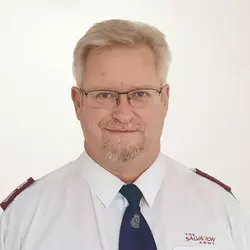
Major Kingsley Layton
Corps Leader, Northampton
Discover more

George Tanton explores how British Salvationists offered fellowship to German prisoners of war during the Second World War.
Resources to lead prayers for peace during gathered worship, in a meaningful and transformative way.
Captain Amy-Jo Battersby (Parkhead with Dennistoun) talks to Major Lynne Shaw about war, Remembrance Sunday and the difference love makes.