
25 December 2025
Love Incarnate! Why God's love came down at Christmas
Major John Waters
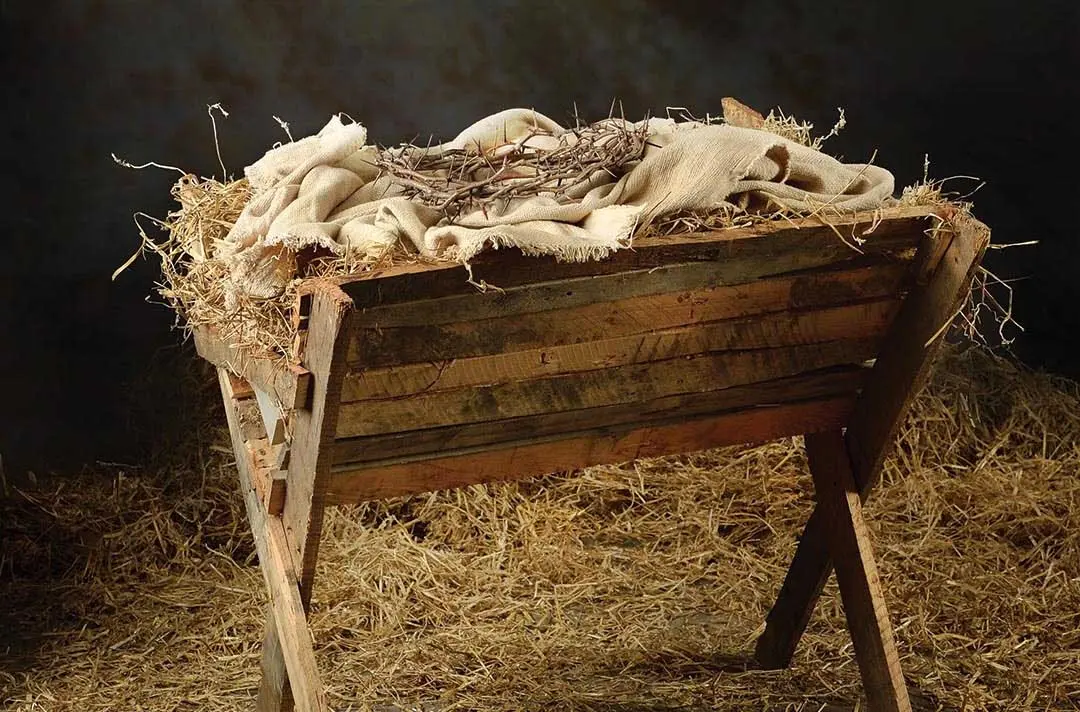
Major John Waters reflects on the link between the Incarnation and the Resurrection.
Eighty years ago, the broadcaster Baroness Mary Stocks visited a recently liberated concentration camp, where she was greeted joyfully by the ill-nourished, emaciated prisoners, who had survived the horrors of incarceration partly because of the infrequent receipt of aid parcels from the Red Cross.
Though still subject to food rationing, Mary was healthy and well-fed, so she was embarrassed when urged to share the simple, inadequate meal of those deprived victims of war. They produced a small tin of fish that, at great cost, they had somehow managed to keep from one of the food parcels. It was their hope that, one day, there would be a special occasion to open the tin – this was it!
As the baroness reflected on eating that tiny fragment of shared fish, she said it was the most moving ‘Holy Communion’ she had ever received. Is there a more unlikely, or more costly, celebration of our Lord’s loving presence?
‘Away in a Manger’ presents us with the image of Love Incarnate in the stable, yet John asserts that, as divine love produced the Incarnation (see John 3:16), it was also divine love that led to the cross (see John 10:14–18).
A hint of what was to come is seen as early as the presentation of the infant Jesus at the Temple in Luke 2:22–35, when Simeon told Mary that ‘a sword will pierce your own soul too’. Vision and vulnerability are inextricably linked in God’s love incarnate – the gift and the cost!
Centuries earlier, Isaiah realised that the hope for his nation did not lie in a conquering hero, nor in the restoration of its romanticised golden past typified by David and Solomon, but in someone who was vulnerable, afflicted and even despised; his will would prosper and after the suffering of his soul, he will see the result of his suffering and be satisfied (see Isaiah 53:11). Such a Saviour was Jesus and it was his suffering that caused the pain in the soul of Mary – the joy of his birth tempered by the vision of the cross that was to come.
In the 1870s, when the Catholic priest Father Damien was ordered to move to a new appointment, the only way he could be faithful to his vow of obedience – yet continue to serve the lepers in his care – was to deliberately contract the disease. Thereafter he no longer addressed his charges as ‘you lepers’ but ‘we lepers’. He echoed the example of a Saviour who ‘lays down his life for the sheep’ (John 10:11).
But the link between Christmas and Easter does not end on Calvary. The symbol of Christianity is not the broken body of Christ on the cross, but an empty cross: a Christ triumphant on a broken cross, for the central vindication of our faith is his resurrection. In whatever situation we find ourselves, the living Christ is there too. As William Blake declared: ‘God is; even in the depths of Hell.’
In A Faith to Proclaim, James S Stewart writes of a great scholar who once visited a friend of his who had worked himself almost to death ministering in a slum. In that room he encountered Christ; there was his friend living in that hell, and there was Christ beside him.
For there is no location or condition from which God, in Jesus, is absent. Christmas, Good Friday, Easter Day – one mighty indivisible act of God’s love!
Written by

Major John Waters
Discover Christmas
-

Be a Star this Christmas!
Salvationist highlights community and fundraising resources to help your corps or centre this Christmas.
-
Ep 153: Christmas Day with General Lyndon Buckingham
General Lyndon Buckingham shares his Christmas message.
-
Love Incarnate! Why God's love came down at Christmas
Major John Waters reflects on the link between Christmas and Easter
-
Me and My Playlist: Ella
Ella (East of England Division) shares her playlist with Ruth Beattie (East of England Division).
-
Ep 152: Advent Sunday Worship with Major Gordon Cotterill
As we reach the end of our Advent series, Major Gordon Cotterill reflects on God’s steadfast love (John 1:1–14).
-

Top 10 Christmas carols
View the top 10 Christmas carols as voted by you.
-

The General’s Christmas message 2025
A Christmas message from General Lyndon Buckingham.
-

Are you feeling the joy of Christmas?
Lieutenant Amy Bayliss-Fox encourages us to look for the new in the familiar story of God's love coming down.
-

John 1: Love shows up
Captain Shelley Ward encourages us to share God's love where it's needed most.
-

Where I see God's love in my life!
Salvationist asks people around the territory how God’s love shows up for them in the everyday.
-
Ep 151: Advent Sunday Worship with Major Gordon Cotterill
On this third Sunday of Advent, Major Gordon Cotterill reminds us that true joy is rooted in God’s presence and promises (Isaiah 12:2–6).
-

Why we serve up Christmas community meals
Lyn Woods finds out how corps and centres connect with their neighbours at Christmas.