
23 December 2025
Wake Up Dead Man: The impossible mystery of grace
Ivan Radford
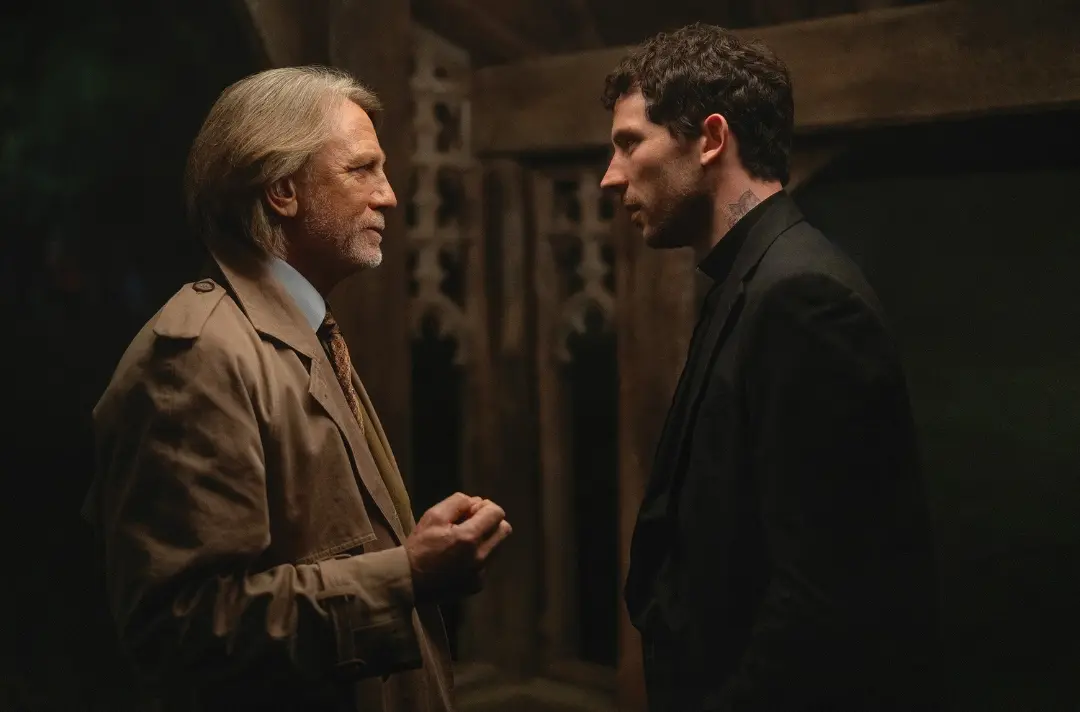
As Knives Out returns to Netflix, Ivan Radford considers what the film has to say about religion, faith and living with compassion.
‘This is something even I have not experienced. A perfectly impossible crime.’ Those are the words of Benoit Blanc, who has returned to Netflix for another case in Wake Up Dead Man. The third film in Rian Johnson’s Knives Out franchise will be on many people’s watchlists, as it once again blends Agatha Christie-esque smarts with a star-studded cast and self-aware wit. Who doesn’t love a murder mystery on a cold winter’s night? The latest outing for the unflappable detective, though, adds a new ingredient to the recipe: faith.
The whodunnit follows Blanc as he is drawn to a locked room puzzle inside a rural church – a staunch priest seemingly murdered right after delivering a no-holds-barred sermon. As the puzzle pieces fall into place, secrets and grudges emerge. And that’s before the really audacious twists kick in, including a biblical spin on the film’s title that raises some extraordinary questions.
The parishioners are a typically colourful bunch of possible culprits, but their suspicion is directed mainly at the priest’s second-in-command. A former boxer turned man of the cloth, he’s an outsider in the parish, with an insubordinate past. Yet in this small village, he ruffles more than a few feathers by attempting not to put his fists up but to spread his arms open wide in compassion.
From the moment he arrives, the clash of personalities is exacerbated by a toxic church community. Shame and bullying rear their heads in different guises, along with greed, ambition and the corrupting pull of power. When everyone’s relationships and reactions become so evidently unloving, it’s perhaps no wonder that the cynical Benoit Blanc struggles to believe in religion – particularly as the congregation find themselves torn into different camps about how the church should move forwards.
Wake Up Dead Man, however, does something that has traditionally been rare on screen: it dares to take faith seriously. And so, while there are miraculous events to explain and politics and disagreements to overcome, Blanc’s case becomes less about deducing a killer’s identity and more about uncovering what it means to follow God – it’s a natural conversation-starter about faith and integrity in any household with a Netflix account.
The answers that Blanc unearths remind us that Christianity is not about elevating ourselves or becoming so consumed by division that any sense of unity is lost. Rather, it’s about humility and taking things one day at a time. That really can seem perfectly impossible – and that’s because it is. Without God working in us, there’s no way we can live that out by ourselves. Zechariah 4:6 cautions: ‘You will not succeed by your own strength or by your own power, but by my Spirit’ (New Century Version). And Philippians 2:13 reassures us: ‘God is working in you to help you want to do and be able to do what pleases him’ (NCV).
As an old Salvation Army song puts it, ‘he’s going to make my life into a miracle, a mighty miracle of a grace’ (SASB 857). Not a miracle of superiority or antagonism, but of grace – remembering that, when we focus on God above earthly noises, influences and distractions, God provides us with our daily bread, all that we need to continue on our journey of becoming more like him. Living with such integrity requires mutual accountability – which is not the same as human judgement – and compassion, as much as it does perseverance and courage. The result isn’t a knives-out culture of hostility, but a welcoming community rooted in a heartfelt hope in God.
It’s a campaign of spiritual warfare that begins in our own hearts. And when our Christlike love is lived authentically from the inside out, it’s often something that people who encounter us haven’t experienced before. Perfect? Not yet. Impossible? Not with God on our side.
Reflect and respond
- Is it possible to know God’s love without his grace? What does that mean for how you love others?
- Read through the lyrics of song 857, then read Ephesians 3:14–21, which inspired it. Who does the melody of your life glorify?
Written by

Ivan Radford
Managing Editor
Latest viewpoints
-
The Celebrity Traitors: What does being faithful look like?
As The Celebrity Traitors returns to our screens, Dan Bate considers what it means to be 100 per cent faithful.
-

Single Friendly Church Week: How welcoming is your church?
At the start of Single Friendly Church Week (27 September – 4 October), Major Andrea Cooper reflects on singleness and how we value people.
-

70 Up: How have you changed as you have grown up?
As 70 Up concludes on ITV, Ivan Radford reflects on growing older.
-

Pray for Nepal and Tibet
After the catastrophic avalanche and flooding, we pray for all the people impacted.
-

Wildfires: Living out hope in the face of despair
In the light of recent wildfires, Major Lynne Shaw considers how we can respond by caring for creation.
-

Back to school: A lesson worth learning
Senior Deputy Head Andrew Mair reflects on the start of the new school year.
-

Is this an end to rough sleeping for good?
Jez Bushnell considers Andy Burnham’s first major promise as prime minister and the government’s commitment to tackling homelessness.
-
Ludwig: The value of a fresh perspective
As Ludwig returns to BBC One, Ivan Radford celebrates the unique ways our minds work.
-

Spider-Man: Brand New Day: Renewed spark
As Spider-Man: Brand New Day swings past superhero fatigue, Sam Bishton asks what renews your energy and passion.
-

The Odyssey: The importance of welcoming strangers
With Christopher Nolan's The Odyssey out now, Captain Chris Button reflects on the importance of hospitality.
-
Toy Story 5: Making time for connection
As Toy Story 5 plays on our screens, Naomi Blowers encourages us not to be distracted from being present with God.
-

The Piano: Playing with purpose
As Channel 4’s music series draws crowds at train stations, Ivan Radford celebrates the power of hearing why people play.